
Revenue Growth without Complexity
AI-Powered Key Takeaways


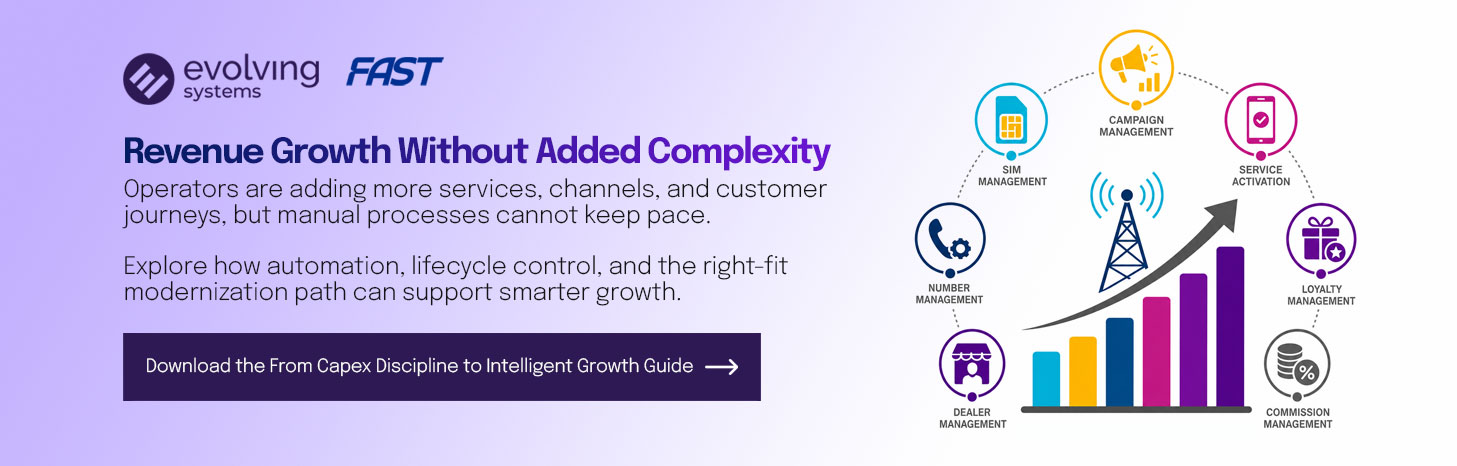
How operators can scale smarter through automation, lifecycle control, and the right-fit modernization path
Telecom operators are entering a new phase of growth discipline. The industry is still expanding, but the economics of expansion are changing. Network build-out remains essential, yet it is no longer enough to carry the next wave of performance. As capital investment becomes more selective, operators are being asked to grow revenue, improve customer experience, launch new services, and support more channels without adding more manual processes or operational complexity.
This is the new challenge: revenue growth without complexity growth.
For years, many operators responded to market demand by adding more layers: more systems, more channels, more partner models, more product variations, more manual workarounds, and more reporting processes. That approach may have been manageable when growth was driven primarily by network expansion and subscriber acquisition. But today’s environment is different. Operators are navigating modest service revenue growth, capex discipline, rising customer expectations, and increasing pressure to monetize existing assets more effectively.
In this environment, the next growth lever is not always more infrastructure. It is smarter execution.
Capex Discipline Is Reshaping Growth Strategy
The shift is visible in industry data. MTN Consulting’s Global Telco Market Tracker has highlighted a market where telco revenues are growing while capex remains under pressure. This points to a more disciplined investment environment where operators must extract greater value from the infrastructure, systems, and resources they already operate.
GSMA’s Mobile Economy research also reinforces the scale and importance of the mobile industry, with mobile technologies and services contributing trillions of dollars to global GDP and supporting digital transformation across economies. At the same time, Analysys Mason’s global telecoms forecasts indicate relatively modest growth in telecom service revenue over the coming years, with core mobile and fixed services still accounting for the majority of retail revenue.
Taken together, these signals create a clear message for operators: growth remains possible, but the old formula of simply building more is not enough. The operators who perform best will be those who reduce friction, automate repeatable workflows, improve lifecycle control, and turn operational efficiency into a source of both revenue protection and revenue creation.
Operational Complexity Threatens Profit Margins
Every new service, partner, channel, and customer journey adds operational load. If operators continue to support this growth with manual processes, fragmented systems, and exception-based workflows, complexity will outpace revenue growth.
This creates hidden margin pressure.
A delayed activation is not just a technical issue. It delays revenue realization. A manual SIM or eSIM process is not just an operational inconvenience. It increases cost-to-serve. Poor visibility into number resources is not just a back-office problem. It can create scarcity, leakage, audit pressure, and missed monetization opportunities. Inconsistent dealer or channel execution is not just a sales issue. It can affect onboarding, compliance, customer experience, and partner performance.
At scale, these small frictions accumulate. They slow growth, increase rework, and make the organization less responsive.
That is why operators need to rethink complexity as an economic issue. The question is not only, “Can we launch more services?” It is, “Can we launch more services without multiplying operational effort?”
Automation as a growth capability
Automation is often discussed as a cost-saving tool, but in today’s operator economics, it should also be treated as a growth capability. The value of automation is not limited to reducing manual tasks. Its greater value is enabling speed, consistency, and control.
For telecom operators, automation can help:
- Shorten the time between order, activation, and revenue.
- Reduce manual intervention in provisioning and lifecycle workflows.
- Improve accuracy across SIM, eSIM, and number resource management.
- Standardize channel execution across dealers, partners, and digital touchpoints.
- Give teams better visibility into operational performance and exceptions.
This matters because growth today is more dynamic. Operators are launching digital plans, eSIM journeys, IoT services, enterprise propositions, loyalty programs, and partner-led offers. These models depend on speed and flexibility. But without automation, every new proposition can create another layer of operational complexity.
Revenue growth without complexity growth requires automation embedded in the workflows that matter most.
Lifecycle control helps operators monetize what they already have
One of the most practical ways to improve operator economics is to strengthen lifecycle control across SIM, eSIM, and number resources.
These resources are often treated as operational inputs, but they carry direct economic value. SIMs, eSIM profiles, IMSIs, ICCIDs, and MSISDNs move through multiple states across manufacturing, distribution, allocation, activation, dormancy, suspension, recycling, and retirement. When those states are not visible or governed, operators incur unnecessary cost and risk.
For example, pre-assigned numbers may sit idle in distribution channels long before a customer activates. SIM inventory may be over-produced or over-distributed to avoid shortages. Dormant numbers may not be recycled quickly enough. Manual reconciliation may make it harder to understand what is active, available, aging, or underutilized.
Lifecycle governance changes the model. Instead of managing resources reactively, operators can manage them dynamically and intelligently. That means allocating resources closer to demand, improving utilization, reducing waste, and strengthening audit readiness.
This is where SIM and number management become economic levers. Better lifecycle control supports efficiency, compliance, and growth. It also creates opportunities to monetize premium number assets, improve channel responsiveness, and reduce the amount of value trapped in idle inventory.
Activation efficiency is revenue acceleration
Activation is one of the most important points in the telecom revenue chain. It is where customer intent becomes service usage and where service usage becomes revenue. When activation is slow, brittle, or overly dependent on manual steps, revenue is delayed, and the customer experience suffers.
For MNOs, activation complexity often comes from scale, legacy systems, multiple channels, and diverse product portfolios. For MVNOs and tier-2 operators, the challenge may be speed, lean execution, and limited operational bandwidth. For converged operators, the issue may be coordinating activation across mobile, fixed, broadband, TV, and enterprise services.
In every model, the principle is the same: activation efficiency improves time-to-revenue.
A modern activation environment should help operators reduce dependencies, simplify provisioning flows, standardize repeatable processes, and support faster service launches. This is especially important as operators expand into more digital and partner-driven propositions. If activation cannot keep up, growth slows at the point where it should begin.
Channel efficiency protects growth as distribution expands
As operators add channels, complexity often shifts to the edge of the business. Dealer networks, agents, retail stores, digital channels, enterprise partners, and marketplace ecosystems all create new opportunities for growth. But they also create new points of inconsistency.
Without strong channel governance, operators may face incomplete onboarding, inconsistent customer checks, activation errors, commission disputes, unclear visibility into performance, and manual reconciliation. These problems not only affect operations. They affect revenue conversion and trust.
Channel efficiency is, therefore, a growth discipline. Operators need simple, consistent, and flexible workflows that support different channel models without creating operational sprawl. Dealer and partner ecosystems should make growth easier, not harder.
This is especially important in markets where assisted channels remain critical to subscriber acquisition and service activation. The operator that can simplify point-of-sale execution while maintaining governance gains an advantage in both speed and control.
Choosing the right modernization path
Revenue growth without complexity growth does not look the same for every operator. A large MNO or CSP may need deep lifecycle control, integration flexibility, and governance across complex environments. A growing MVNO or tier-2 operator may need the same business outcomes, but with a faster, leaner, and lower-complexity deployment model.
This is where the path to modernization matters.
Evolving Systems solutions: for operators managing scale and complexity
For established MNOs, CSPs, and converged operators, Evolving Systems solutions support the operational areas where efficiency and revenue growth increasingly intersect.
Solutions such as Tertio Service Activation, Dynamic SIM Allocation, Total Number Management, Smart Dealer, Evolution, and Evolution with AIQ help operators improve activation, lifecycle control, channel execution, customer engagement, and AI-enabled decisioning without adding unnecessary complexity.
- Improve activation efficiency across complex service environments.
- Strengthen governance of SIM, eSIM, and number resources.
- Reduce manual lifecycle processes and operational exceptions.
- Improve dealer, partner, and channel visibility.
- Turn customer data into more consistent engagement and next-best actions.
The objective is not technology for its own sake. It helps operators turn operational discipline into business value: faster activations, better resource utilization, stronger channel governance, more consistent customer engagement, and smarter growth.
FAST solutions: for MVNOs, tier-2 operators, and agile telcos that need speed without complexity
For MVNOs, mid-market operators, tier-2 telcos, and new market entrants, FAST provides a more modular, SaaS-led path to growth. FAST is designed for operators who need results quickly, without heavy infrastructure requirements or unnecessary complexity.
FAST offers ready-to-deploy modules across campaign management, loyalty management, number management, dealer management, and dealer and commission management. Its value lies in helping lean teams launch faster, operate more efficiently, and scale based on their needs, when they need it.
This path is especially relevant for operators who need to:
- Launch campaign, loyalty, number, dealer, or commission capabilities quickly.
- Improve dealer and channel execution without large-scale IT overhead.
- Manage number inventory and monetization through a centralized cloud-based platform.
- Start small and expand capabilities as the business grows.
- Control cost while still accessing telecom-grade capabilities.
For these operators, revenue growth without complexity growth means choosing a platform that matches their size, speed, and budget. FAST supports that by giving operators a practical way to modernize operations without taking on the burden of enterprise-scale implementation.
One principle, two paths
Whether operators choose Evolving Systems enterprise solutions or FAST modules, the principle is the same: growth should not require more manual effort at every step.
For larger operators, the priority may be governance, integration, lifecycle control, and scale. For MVNOs and tier-2 operators, the priority may be speed, simplicity, affordability, and quick deployment. Both paths support the same broader goal: helping telecom businesses grow revenue while keeping operations leaner, clearer, and more controllable.
Closing thought
The next phase of telecom growth will not be won by adding complexity to chase revenue. It will be won by operators who can scale services, channels, and customer experiences while simplifying the operating model that supports them.
Capex discipline is making this shift more urgent. Operators can no longer afford to let manual processes expand every time the business adds a new service or route to market. The future growth playbook is clear: automate what slows you down, govern what creates leakage, and modernize the workflows that turn demand into revenue.
That is how operators move from growth with complexity to intelligent growth with control.