
Why Resource Efficiency Should Be Part of Every Telecom Operator’s ESG Strategy
AI-Powered Key Takeaways


When sustainability enters the conversation, carbon emissions almost always take center stage.
For telecom operators, this has translated into ambitious net-zero commitments, investments in renewable energy, more energy-efficient networks, and greener data centers. These initiatives are critical and will continue to shape the industry’s ESG agenda.
But carbon is only one part of the sustainability equation.
Behind every network is a complex ecosystem of operational resources: from numbering assets and SIM inventories to customer interactions and business processes. How efficiently these resources are managed has a direct impact on both business performance and sustainability outcomes.
As ESG strategies continue to mature, telecom operators have an opportunity to broaden their perspective. Alongside carbon reduction, resource efficiency should become a core pillar of every telecom ESG strategy.
Looking Beyond Carbon
Carbon reduction is often the most visible measure of sustainability because it is relatively easy to quantify and communicate.
However, sustainability is fundamentally about making better use of available resources. That principle extends far beyond electricity consumption or greenhouse gas emissions.
For telecom operators, resource efficiency means maximizing the value of the assets and processes already in place before introducing additional ones.
This includes physical resources, such as SIM inventory, as well as digital resources like numbering assets, operational data, and automated workflows.
When these resources are underutilized or poorly managed, operators don’t just incur higher costs. They also generate unnecessary waste and reduce operational resilience.
ESG, therefore, should not only ask how much energy an operator consumes. It should also ask how efficiently the business uses the resources it already has.
The most sustainable resource isn’t the newest one. It’s the one you’re
already using efficiently.
Resource Efficiency Creates a Double Dividend
One of the biggest misconceptions surrounding ESG is that sustainability and profitability exist on opposite sides of the equation. In reality, resource efficiency demonstrates that the two often move together.
When operators optimize resources, they simultaneously reduce operational waste and improve financial performance.
Better utilization means fewer unnecessary assets, less duplication, lower administrative overhead, and more effective operational planning.
These improvements create what could be described as a double dividend.
On one side, operators reduce unnecessary resource consumption and improve sustainability outcomes.
On the other hand, they lower costs, improve agility, and create stronger operational foundations for future growth.
Rather than treating ESG as a cost center, resource efficiency transforms it into
a driver of long-term business value.
Resource Efficiency Starts with Everyday Operations
Improving sustainability does not always require transformational change.
Often, the biggest opportunities exist within everyday operational processes that quietly influence performance at scale.
Consider areas such as:
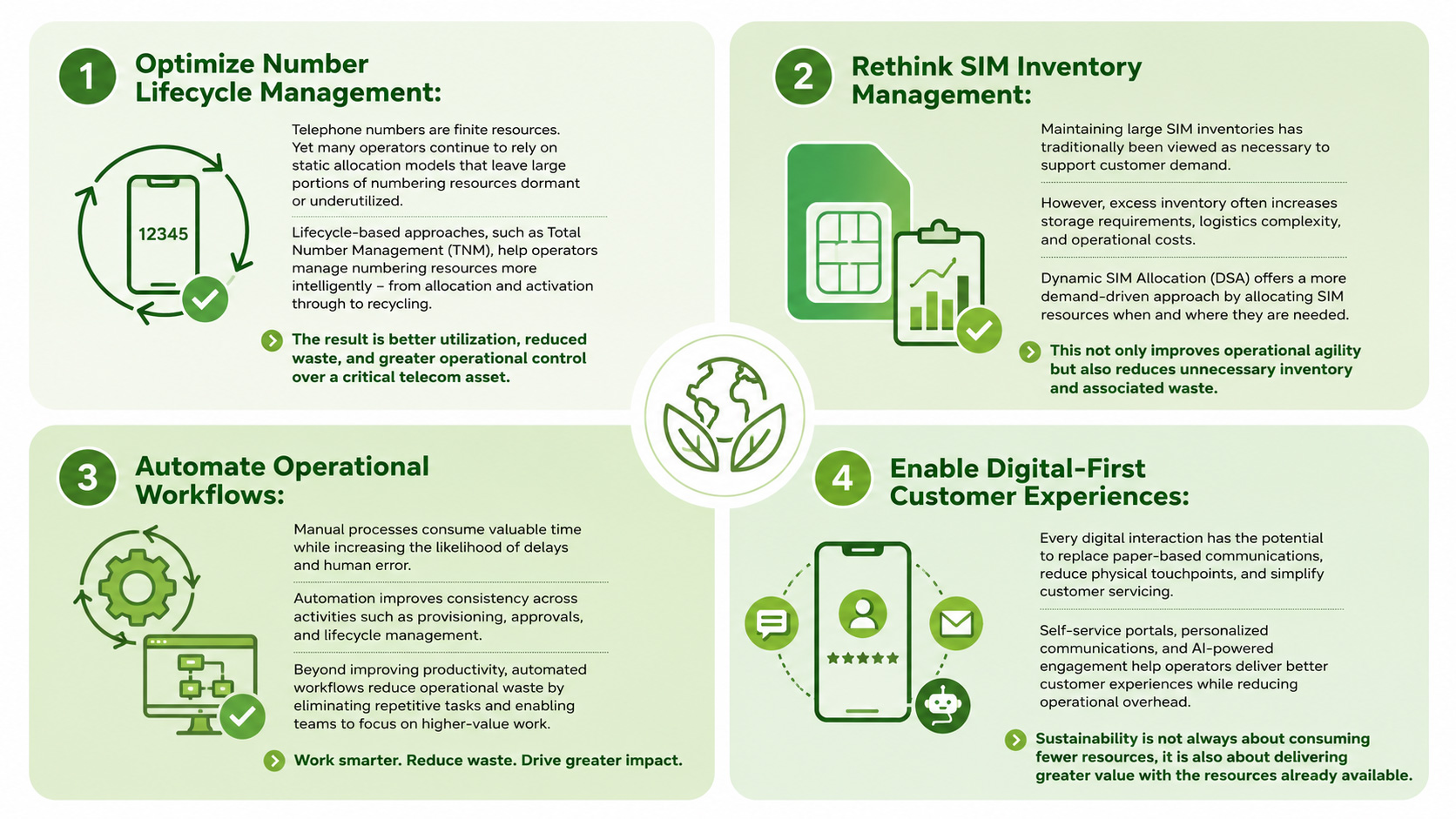
- Number management, where optimizing the lifecycle of numbering resources helps improve utilization and minimize unnecessary allocation of finite assets.
- SIM lifecycle management, where demand-driven allocation reduces excess inventory while improving operational flexibility.
- Service provisioning, where automation accelerates activations while reducing manual intervention and process inefficiencies.
- Customer engagement, where digital-first interactions reduce paper consumption, streamline servicing, and create more efficient customer journeys.
Individually, each of these improvements may appear modest.
Collectively, they reshape how efficiently an operator uses its resources, delivering benefits that extend well beyond operational performance.
Four Areas Where Telecom Operators Can Drive Resource Efficiency
Resource efficiency is not a single initiative. It is the cumulative result of smarter operational decisions across the business.
Why Resource Efficiency Is Becoming an ESG Priority
Investors, regulators, and enterprise customers are increasingly looking beyond environmental commitments to understand how organizations operate.
Questions around operational resilience, resource utilization, and responsible innovation are becoming more prominent in ESG discussions.
For telecom operators, this represents an important shift.
Future ESG performance is unlikely to be measured solely through carbon metrics.
Increasingly, operators will also be expected to demonstrate how effectively they optimize assets, automate processes, and reduce operational inefficiencies.
Resource efficiency therefore becomes more than a cost optimization strategy.
It becomes a measurable indicator of organizational maturity.
From Operational Efficiency to Competitive Advantage
Every telecom operator is pursuing efficiency.
The differentiator lies in how those efficiency gains are used.
Organizations that continuously optimize resources are often better positioned to respond to changing customer demands, scale services more effectively, and invest in future innovation.
Their operational agility becomes a competitive advantage.
At the same time, stronger resource utilization supports broader ESG objectives by reducing waste, extending asset value, and improving resilience across the business.
This creates a powerful cycle where operational excellence strengthens sustainability and sustainability, in turn, supports long-term business performance.
Resource efficiency creates a rare advantage: it improves both sustainability
outcomes and business performance.
Our Perspective: Building Sustainability into Everyday Operations
At Evolving Systems, we believe sustainability is most effective when it is embedded into the operational foundations of telecom.
That means designing systems that help operators improve visibility, optimize finite resources, and automate everyday processes rather than treating ESG as a standalone initiative.
Solutions such as Total Number Management (TNM) help operators maximize the value of numbering resources throughout their lifecycle, improving utilization while reducing unnecessary allocation.
Dynamic SIM Allocation (DSA) applies the same philosophy to SIM management, enabling operators to adopt more efficient, demand-driven operational models.
Together with intelligent automation and real-time operational insights, these capabilities help operators translate sustainability ambitions into measurable operational improvements.
For us, ESG is not simply about reducing environmental impact.
It is about helping telecom operators build businesses that are more efficient, more resilient, and better prepared for the future.
Conclusion: Looking Beyond Carbon
Carbon reduction will rightly remain one of the defining priorities of telecom ESG.
But sustainability cannot end there.
The industry’s greatest opportunity may lie in improving how existing resources are managed every day.
Whether optimizing numbering resources, modernizing SIM management, automating workflows, or enabling digital-first customer experiences, resource efficiency allows operators to reduce waste while strengthening business performance.
The operators that lead tomorrow will recognize that sustainability is not built solely through large-scale environmental initiatives.
It is also shaped by thousands of operational decisions made every day.
Looking beyond carbon is not about shifting focus away from emissions.
It is about recognizing that true sustainability is achieved when every resource – physical, digital, and operational – is used to its fullest potential.