
Cloud-Ready Service Provisioning: How Telecom Operators Can Improve Efficiency, Resilience, and Security
AI-Powered Key Takeaways


Telecom operators are under constant pressure to do more with less. Networks are becoming more complex, customer expectations continue to rise, and operational teams are expected to accelerate service delivery while maintaining strong security and cost control.
In this environment, service provisioning platforms need to do more than support activation. They need to help operators simplify deployment, strengthen operational resilience, reduce risk, and make better infrastructure decisions for long-term efficiency.
That is why cloud-ready, containerized provisioning architectures are becoming an increasingly important part of telecom transformation strategies.
Why Modern Service Provisioning Needs a Different Architecture
Legacy provisioning environments often create friction across the service lifecycle. They can be harder to maintain, slower to update, and more difficult to align with hybrid network environments that span traditional infrastructure, virtualized services, and newer digital ecosystems.
Tertio is positioned as a cloud-based telecom provisioning platform that supports cloud-native technologies and containerized deployments, helping operators improve efficiency, security, and operational flexibility.
For telecom leaders, this matters because service provisioning is not just a technical function. It affects:
- Time-to-market for new services
- Operational reliability across complex environments
- Compliance with security and audit requirements
- The cost of maintaining and evolving the activation layer
A provisioning platform that is easier to deploy, manage, and secure can create measurable benefits across all of these areas.
What Containerization Brings to Telecom Provisioning
Containerization helps standardize how applications are packaged and deployed across development, testing, staging, and production environments. For Tertio, containerized deployment speeds up updates and enables more reliable introduction of new services.
For telecom operators, the value is practical:
- More consistent deployments: Each container includes the components needed to run predictably across environments, reducing the mismatch that can delay releases.
- Simplified updates: New provisioning capabilities can be introduced with less operational disruption, helping teams move faster without unnecessarily exposing live services to risk.
- Better fault isolation: When functions are separated into containers, issues can be contained more effectively, limiting their impact on the wider provisioning workflow.
This is especially relevant for operators supporting multiple services, vendors, and network domains. A more modular architecture helps reduce the burden on operations teams while supporting more controlled service evolution.
How Cloud-Ready Deployment Supports Operational Efficiency
Cloud-ready provisioning does not simply mean moving workloads into another environment. For telecom operators, it means having the flexibility to deploy and manage service provisioning in ways that better align with current and future operating models.
For decision-makers, the benefit is not just technical agility. It is about improving how capacity, cost, and performance are managed over time.
A cloud-ready service provisioning approach can support:
- More efficient infrastructure planning
- Better alignment between demand and available capacity
- Reduced over-provisioning
- Stronger support for service growth without unnecessary architecture disruption
This is particularly valuable in fast-changing environments where service volumes, launch priorities, and network demands can shift quickly.
Why Security Must Be Built Into the Provisioning Layer
Security is a board-level issue in the telecom industry. Provisioning systems sit close to critical service logic and subscriber-related processes, so weaknesses in access control, logging, or traceability can create serious operational and regulatory risk.
Tertio’s cloud and containerization positioning includes support for security measures such as multi-factor authentication, encrypted logs, digital signatures, and secure access protocols. These features are presented as part of a broader effort to protect data integrity and support compliance with telecom security requirements.
For telecom executives, this creates several advantages:
- Stronger access governance: Sensitive changes can be restricted to verified personnel.
- Better auditability: Encrypted logs and traceable actions make it easier to demonstrate accountability and support investigations when needed.
- Improved compliance readiness: Security controls that are built into the platform help reduce the effort required to meet internal and external standards.
In other words, security features are not just about protection. They also improve confidence, control, and operational discipline.
Can Service Provisioning Modernization Also Reduce Cost?
It should.
Modernization efforts are increasingly judged on two things: whether they improve operations and whether they deliver clear financial value. Telecom operators are not only looking for better technology. They are also looking for more efficient ways to manage long-term costs.
That is where architectural flexibility matters. Having the option to move from Oracle to PostgreSQL gives operators a more cost-effective database alternative without sacrificing core performance. For many telecom organizations, this presents an opportunity to reduce infrastructure-related costs while maintaining the reliability required to support critical provisioning processes.
For telecom leaders, that can help:
- Lower licensing and platform-related costs
- Improve budget efficiency
- Free up investment for service innovation and customer-facing priorities
- Reduce the long-term cost burden of maintaining the provisioning stack
When evaluating service provisioning platforms, cost structure is no longer a secondary consideration. It is part of the broader business case for modernization.
Resilience Matters as Much as Speed
Speed is important, but resilience is what sustains service confidence.
Tertio’s containerized architecture supports resilient operations by isolating functions so that issues in one area do not necessarily disrupt the entire provisioning workflow.
This is critical in environments where downtime or provisioning failures can affect customer experience, operational productivity, and revenue.
A resilient provisioning architecture helps organizations:
- Contain faults more effectively
- Reduce service disruption
- Recover more cleanly from localized issues
- Maintain confidence across high-demand service environments
That combination of resilience and control is particularly important for operators supporting large subscriber bases, converged services, or multi-domain network ecosystems.
What Telecom Leaders Should Prioritize in Service Provisioning
For telecom managers and decision-makers, the question is no longer whether service provisioning needs to evolve, but which platform will best support the business over time. The provisioning layer now plays a direct role in how quickly services can be launched, how securely operations are managed, and how efficiently networks can adapt to changing demands.
A modern approach should give operators the flexibility to deploy in cloud-ready environments, introduce updates more reliably through containerized delivery, strengthen security and auditability, improve resilience across the service lifecycle, and make smarter long-term cost decisions.
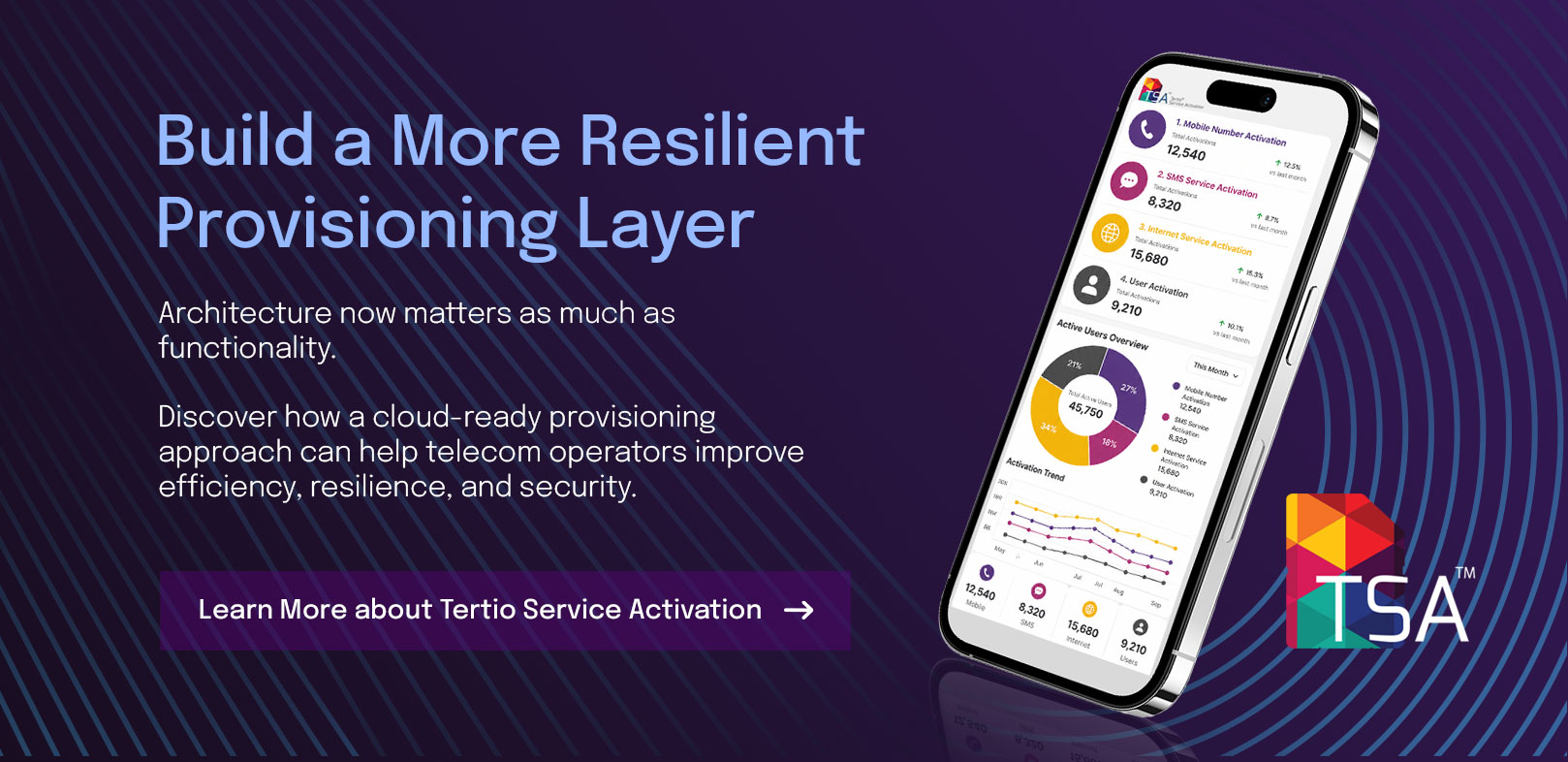
This is why architecture matters as much as functionality. A provisioning platform that supports efficiency, governance, and operational control can help operators simplify deployment, reduce risk, and build a stronger foundation for future growth.
If you are looking to modernize service provisioning with greater efficiency, resilience, and security, Tertio offers a practical path forward. Contact Evolving Systems to learn more about how Tertio’s cloud-ready, containerized architecture can support your operational goals. Our team is available to discuss your current environment and provide a free consultation on the best approach for your business.