
Closing Revenue Leakage Gaps in Multi-Tier Airtime Distribution
AI-Powered Key Takeaways


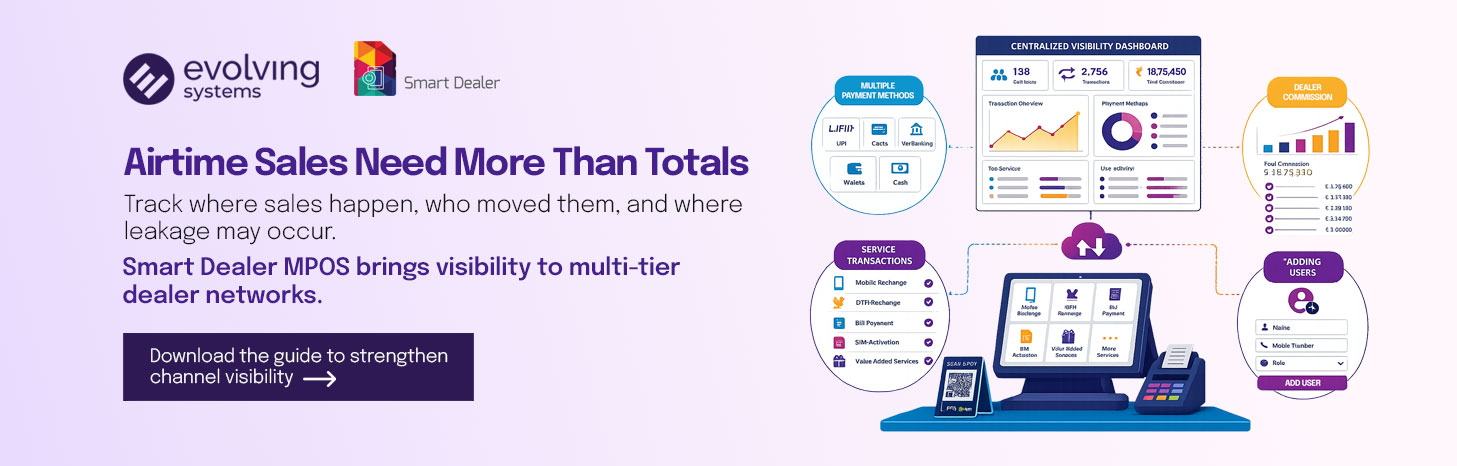
Most telecom operators can tell you how much airtime a dealer sold last month. But can they tell you where it was sold, who actually moved it through the channel, or whether every transaction was legitimate?
This is critical for operators with multi-tier dealer networks.
Across provinces, islands, rural corridors, and informal distribution chains, airtime distribution rarely moves in a straight line. It may pass from a master distributor to regional dealers, sub-dealers, agents, kiosks, and field teams before reaching the subscriber. Each layer expands market reach, but each layer can also introduce blind spots.
Blind spots that are not just reporting gaps. They can become revenue leakage.
When operators cannot see where airtime is sold, which sub-dealer moved it, or whether transactions followed approved rules, they are left managing dealer performance largely on trust. In fast-moving prepaid markets, trust alone is not enough.
A more connected approach to telecom dealer management is needed. This is where Smart Dealer MPOS becomes highly relevant.
The Airtime Distribution Blind Spot
Airtime sales are often tracked at the surface level. Operators may know the total value sold by a master dealer or regional distributor, but visibility can weaken further down the chain.
This creates several unanswered questions:
- Which locations are generating the strongest airtime sales?
- Which sub-dealers or agents are actually driving performance?
- Are transactions happening in approved areas?
- Are commissions being paid to the right channel participants?
- Are unusual recharge patterns being detected early enough?
- Are stock and float movements aligned with actual demand?
When these questions cannot be answered confidently, channel teams operate with partial visibility. They may see the total airtime volume, but not the true movement behind it.
That is where leakage can occur. Unauthorized recharges, unclear ownership of sales, phantom stock movements, float manipulation, and disputed commissions can remain hidden until they become difficult or expensive to correct.
Why Multi-Tier Networks Need Stronger Dealer Visibility
Multi-tier dealer networks are essential for subscriber growth and market reach, especially in markets where physical distribution remains critical. But the same structure that enables reach also creates complexity.
A dealer ecosystem may include:
- Master distributors
- Regional dealers
- Sub-dealers
- Retail agents
- Field promoters
- Informal or semi-formal sales points
- Rural and remote channel partners
Each participant plays a role in moving airtime, SIMs, recharges, and services closer to the customer. But without the right tracking and governance, the operator may only see the first or second layer clearly.
This creates a risk: the network may appear productive from the top, while operational leakage grows beneath the surface.
For commercial, CVM, distribution, and channel operations teams, the issue is not simply whether sales are happening. The issue is whether sales are happening in the right place, through the right channel, under the right rules, and with the right commission logic.
Smart Dealer MPOS: Moving from Trust-Based Tracking to Data-Led Control
Smart Dealer MPOS helps telecom operators strengthen dealer network control by connecting airtime sales, location tracking, hierarchy visibility, commission management, and real-time reporting into a more structured dealer management environment.
Rather than treating airtime sales as standalone transaction records, Smart Dealer MPOS helps operators understand the context behind those sales.
That context includes:
- Where the transaction happened
- Which dealer or sub-dealer performed it
- Which hierarchy does the dealer belong to
- Whether the transaction followed the eligibility and access rules
- How performance compares across locations, groups, and products
- How commission calculations should be applied
This turns dealer management from a retrospective reporting exercise into a more active operating model.
Geo-Tagged Transactions: Knowing Where Sales Really Happen
Location is one of the most important missing data points in traditional airtime distribution tracking.
A dealer may be assigned to one location but sell in another. A sub-dealer may be moving stock in an unapproved area. A high-performing region may actually be receiving volume from outside its territory. Without geo-tagged transaction data, these patterns are difficult to identify.
Smart Dealer MPOS supports location-aware tracking that helps operators understand where airtime sales and related dealer activities occur.
This enables teams to:
- Confirm whether dealers are operating in approved locations.
- Identify high-performing sales zones.
- Detect unusual location patterns.
- Support field teams more effectively.
- Improve territory planning and resource allocation.
In markets with large rural footprints or dispersed island geographies, this visibility can be especially valuable. It allows operators to understand not only how much airtime was sold, but where demand is actually being captured.
Dealer Hierarchy Visibility: Seeing Beyond the Master Distributor
Many operators have visibility at the master dealer level, but limited insight into the layers below. This creates challenges in performance tracking, commission assignment, and accountability.
Smart Dealer MPOS supports hierarchy-based dealer management, allowing operators to structure and monitor performance across multiple channel layers.
This means teams can track performance by:
- Dealer group
- Sub-dealer
- Agent
- Location
- Product or service type
- Territory or region
With stronger hierarchy visibility, operators can better understand who is contributing to sales performance and where bottlenecks are emerging.
This is important because not all underperformance is visible at the top. A master dealer may appear stable, while certain sub-dealer groups are inactive, underperforming, or operating outside expected patterns. Smart Dealer MPOS helps make these differences visible.
Automated Commission Management: Reducing Disputes and Manual Reconciliation
Dealer trust is closely tied to commission transparency. When commission calculations are delayed, unclear, or manually reconciled, disputes become more likely.
In multi-tier airtime distribution, commissions can become complex. Different rates may apply by:
- Dealer hierarchy
- Product type
- Sales volume
- Region
- Campaign
- Performance target
- Time period
Manual calculation creates risk. It can lead to inconsistent payouts, delayed settlements, and disputes over who sold what.
Smart Dealer MPOS helps address this through automated commission management and performance tracking. By linking sales activity to dealer hierarchy and applicable rules, operators can reduce manual reconciliation and provide clearer visibility into commission outcomes.
This supports:
- More accurate commission calculations
- Faster payout cycles
- Fewer disputes
- Better incentive alignment
- Stronger dealer confidence
When dealers understand how performance translates into incentives, they are more likely to stay engaged and aligned with operator goals.
Fraud and Leakage Control: Detecting What Should Not Happen
Revenue leakage is not always the result of a major system failure. It often appears in small, repeated gaps:
- Recharges processed from unexpected locations.
- Airtime movement outside approved territories.
- Stock activity that does not match sales patterns.
- Commission claims that do not align with transaction data.
- Dealers operating beyond assigned permissions.
- Repeated exceptions that are only visible after reconciliation.
Smart Dealer MPOS helps operators identify and reduce these risks by bringing dealer activity into a more controlled and visible environment.
With better tracking, validation, and reporting, operators can detect suspicious patterns earlier and act before they become larger financial issues.
This does not mean every exception is fraud. Sometimes it is a training issue, a process gap, or a legitimate operational workaround. But without visibility, operators cannot distinguish between healthy channel activity and potential leakage.
Real-Time Dealer Performance Dashboards
Month-end reporting is too late for many channel decisions.
If a region underperforms, if a dealer stops selling, or if unusual airtime activity appears, channel teams need to know quickly. Waiting until the end of the month means opportunities are missed, and problems continue unchecked.
Smart Dealer MPOS provides real-time performance visibility across the dealer network. Operators can monitor sales activity, dealer performance, location trends, and product movement more effectively.
This helps commercial and channel teams:
- Identify underperforming regions early.
- Spot high-performing dealers and replicate success.
- Monitor airtime sales velocity.
- Improve support and training allocation.
- Make faster decisions on campaigns and incentives.
For CVM teams, this visibility can also support more targeted engagement strategies. If a region shows strong airtime demand, campaigns can be refined. If a dealer group is underperforming, offers, training, or support can be adjusted.
Why This Matters for CVM, Distribution, and Channel Teams
Airtime distribution is not just a sales function. It affects revenue, customer engagement, channel trust, and market responsiveness.
For CVM teams, poor dealer visibility limits the ability to understand customer behavior and recharge patterns at the local level.
For distribution teams, weak stock and airtime tracking can lead to mismatches, disputes, and missed opportunities.
For channel operations teams, a lack of real-time visibility into dealer performance makes it harder to manage productivity and compliance across regions.
Smart Dealer MPOS helps these teams move from fragmented reporting to a more connected view of dealer execution.
Instead of asking only, “How much was sold?” operators can begin asking better questions:
- Where was it sold?
- Who sold it?
- Was it sold under the right conditions?
- Did the right dealer receive credit?
- Is the trend normal?
- Does the channel need support?
- Is there leakage that should be investigated?
These are the questions that separate basic sales reporting from true dealer network management.
Smart Dealer MPOS and Stock Management
Airtime and recharge visibility often go hand in hand with stock management. If SIMs, devices, or recharge-related inventory are not tracked accurately, sales opportunities can be lost even when customer demand exists.
Smart Dealer supports stronger dealer operations by improving visibility across dealer activity and stock-related execution. This helps operators reduce mismatches between what central teams believe dealers have and what dealers actually hold or move.
Better stock visibility supports:
- Fewer missed sales
- More accurate allocation
- Better dealer accountability
- Improved planning for campaigns and regional pushes
- Reduced disputes across channel tiers
When stock movement, dealer activity, and sales performance are viewed together, operators gain a more complete picture of channel health.
From Dealer Network Black Box to Data-Led Execution
If a dealer network becomes unclear beyond the master distributor level, the issue is not just distribution complexity. It is a visibility problem.
Modern telecom operators need more than airtime totals. They need dealer-level, location-level, and hierarchy-level intelligence to support real-time decision-making.
Smart Dealer MPOS helps close this gap by bringing together:
- Geo-tagged transaction visibility
- Multi-tier dealer hierarchy tracking
- Automated commission management
- Fraud and leakage control
- Real-time dealer performance dashboards
- Stock and activity visibility
Together, these capabilities help operators shift from reactive reconciliation to proactive dealer management.
Conclusion
Airtime distribution remains one of the most important engines of prepaid growth. But in multi-tier dealer networks, growth can be undermined by blind spots.
If operators can only see how much airtime was sold, but not where, by whom, or under what conditions, revenue leakage can continue unnoticed.
Smart Dealer MPOS helps telecom operators strengthen dealer network visibility, improve commission transparency, reduce operational leakage, and manage channel performance with greater confidence.
In today’s telecom environment, the difference between managing a dealer network on trust and managing it on data can be the difference between hidden leakage and measurable growth.
Contact us to learn more about how Smart Dealer supports dealer management, airtime distribution tracking, and sales channel visibility.