
Where Telecom Customer Journeys Still Break Down
AI-Powered Key Takeaways


Today’s telecom customers expect seamless, instant, and personalized experiences—but the reality is far more complex. With countless ways to connect—browsing plans online, purchasing through digital channels, activating services, managing accounts via apps, or seeking support and offers across platforms—customers now demand journeys that are as connected as the technology they use. However, an explosion of digital touchpoints hasn’t guaranteed a better customer journey. Customers still repeat information, switch channels, wait for actions to complete, or receive inconsistent messages. The real breakdown isn’t usually with a single touchpoint—it’s in the gaps and handoffs between them.
Digitizing a touchpoint doesn’t necessarily digitize the journey.
The journey doesn’t break at the touchpoint
Operators have invested heavily in improving individual customer interactions. Websites have become easier to navigate, apps have added self-service capabilities, and digital channels have expanded the ways customers can engage.
But customers don’t experience these as separate systems. They experience a single journey.
Consider a typical sequence: a customer discovers an offer online, compares plans, completes a purchase, activates a service, manages usage through an app, and eventually contacts support. If the customer’s context is lost at any point, the experience becomes fragmented.
Research reinforces the scale of this problem. Ericsson found that smartphone users took an average of 2.2 attempts and 4.1 days to successfully complete an interaction with a telecom provider. The research also found that customer satisfaction fell significantly when completing an interaction took more than a day.
The implication is straightforward: a channel can perform well in isolation while the overall journey performs poorly.
Where telecom customer journeys still break down
Discovery to purchase: when intent meets complexity
The first point of friction can appear before a customer becomes a subscriber.
A customer may discover a plan through a digital advertisement, research it on a website, and then encounter a very different experience when trying to purchase it. Product information may vary between channels, the purchasing process may require unnecessary steps, or a digital journey may ultimately depend on manual intervention.
This matters because customer intent is at its strongest immediately before purchase.
KPMG’s 2025 India CX research found that 40% of network-operator customers considered the pre-purchase stage the most impactful stage in defining brand perception. Ease of comparing plans and assessing options were among the key experience parameters.
The lesson is that acquisition isn’t simply about generating interest. It is about reducing the distance between intent and completion.
Onboarding to activation: when the first experience takes too long
The journey doesn’t become seamless simply because the customer has made a purchase.
Registration, identity verification, SIM or eSIM activation, and service provisioning can introduce new sources of friction. Delays and unclear status updates can leave customers wondering whether something has gone wrong.
From the operator’s perspective, these may be separate operational processes. From the customer’s perspective, they are simply part of getting started.
That makes time-to-value an important customer experience measure: how quickly can a customer move from deciding to buy to actually using the service?
The shorter that gap, the less opportunity there is for frustration to enter the relationship.
Self-service to support: when digital doesn’t mean resolution
Digital self-service has made it easier for customers to find information and complete routine tasks. But a digital channel creates little value if it simply moves the customer towards another channel when something goes wrong.
Consider the familiar journey:
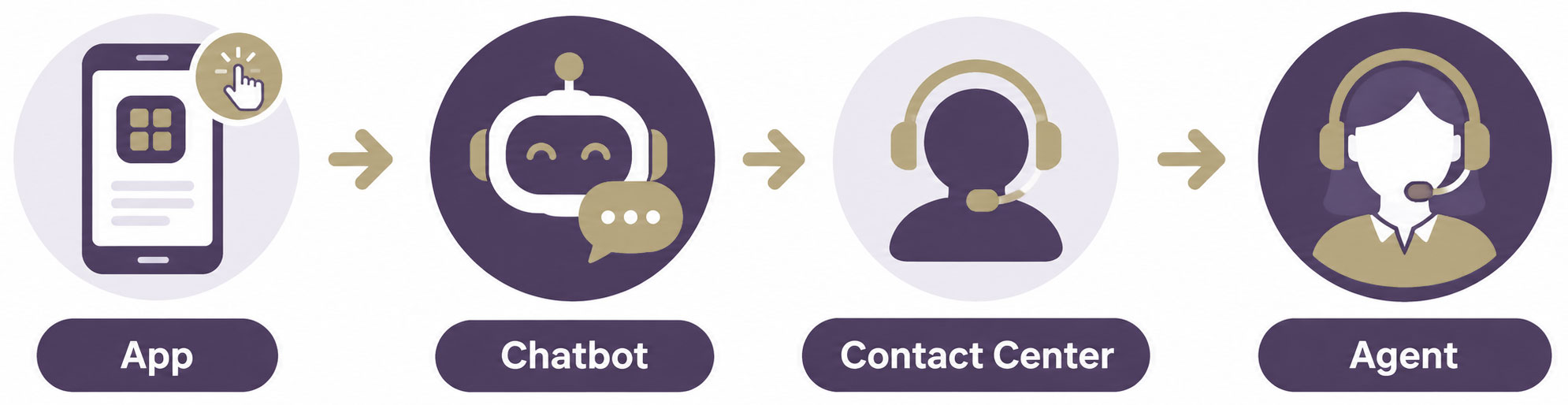
The problem isn’t necessarily that a human agent becomes involved. The problem is when the customer’s context doesn’t travel with them.
Having to explain an issue again, repeat information already provided, or start a process from scratch turns a supposedly connected experience into a series of disconnected interactions.
The goal should therefore be digital resolution, not digital access alone.
Personalization to relevance: when data doesn’t translate into action
Telecom operators have access to enormous volumes of customer data, from usage and recharge behavior to interactions, purchases, and service activity. Yet that doesn’t mean they know what customers need next.
Offers arrive by SMS, app, or customer service; often out of sync and disconnected. True personalization isn’t just about a name or a segment.
The real question: What’s the most relevant interaction for this customer, right now, based on everything we know?
Engagement to retention: when the journey goes quiet
The journey doesn’t stop at acquisition; it continues through every interaction. But after the initial excitement, engagement often slips into a reactive mode. Subtle changes in usage or declining activity are warning signs, but only if operators spot and act on them early.
The challenge is recognizing those signals early enough to act.
Journeys that respond in real time to behavior are fundamentally different from ones built around periodic campaigns and scheduled communications.
Why does journey friction persist?
Most problems stem from the same roots:
Fragmented systems, lost customer context, and a focus on optimizing channels instead of the whole journey. When different platforms handle separate stages, and teams lack a unified view, even the best digital channels create disconnected experiences. The toughest CX challenges aren’t within a channel—they show up in the handoffs between channels, systems, and decisions.
Customers don’t think in terms of systems, platforms, or departments. They think in terms of getting something done. Every unnecessary handoff becomes part of their experience.
From touchpoint optimization to journey orchestration
Fixing these gaps requires a shift from optimizing individual touchpoints to orchestrating the journey around the customer.
That starts with maintaining a continuous view of customer context. Information should follow the customer, not be recreated every time they move between channels.
It also means coordinating engagement around lifecycle and behavior rather than treating every interaction as an isolated campaign.
This is where platforms like Evolution can play a broader role – the customer engagement platform brings together customer value management, loyalty, gamification and omnichannel engagement, with capabilities designed to coordinate segments, offers, campaigns and interactions across touchpoints.
The objective is not simply to create another customer-facing channel. It is to provide a foundation for more consistent, lifecycle-driven engagement.
From connected journeys to intelligent journeys
Connected journeys solve an important problem: they help customer context move across touchpoints, so each interaction can build on what happened before.
But having context creates a new question:
What should happen next — and should anything happen at all?
This is where AIQ+ adds value.
AIQ+ is the customer decision intelligence layer within Evolution. It sits between the customer data and insights an operator already has and the campaigns, offers, loyalty treatments, and other actions delivered through customer channels.
Before an action is executed, AIQ+ helps determine:
- Whether the operator should act
- When the right moment to act is
- What action or offer is most appropriate
- How that action should be delivered
This matters because not every customer signal requires a response. Some actions should happen immediately. Others should be delayed, prioritized differently, or suppressed altogether.
AIQ+ brings greater governance to this decision-making process, helping operators move beyond broad campaign execution toward engagement that is more consistent, measurable, and explainable.
The distinction is simple:
A connected journey understands what has happened.
An intelligent journey decides what should happen next.
With Evolution and AIQ+, the journey becomes:
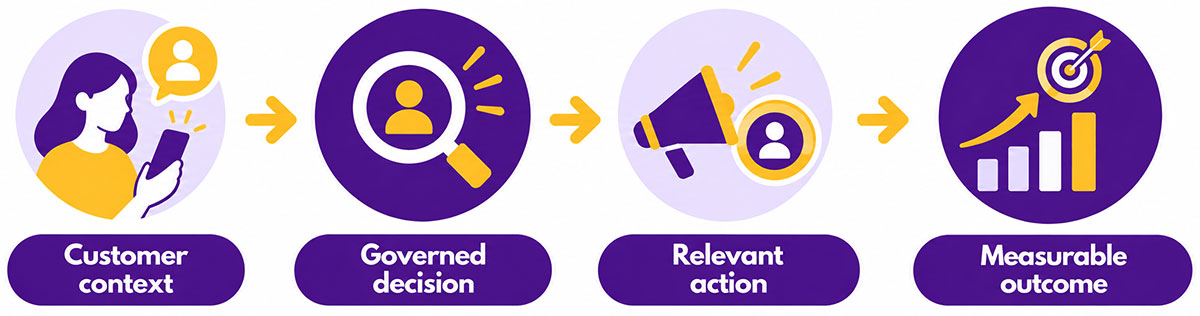
The result is not more automation. It is more governed and intentional customer engagement, where each action has a clearer reason and a stronger connection to customer and business value.

The goal isn’t more touchpoints. It’s fewer gaps.
Telecom operators don’t necessarily need another channel to improve customer experience.
They need the channels, systems, and decisions they already have to work together more effectively.
The strongest customer journeys are those where context carries across interactions, actions happen without unnecessary intervention, and engagement responds to what customers actually need.
As telecom becomes increasingly digital, competitive differentiation will depend less on how many touchpoints an operator offers and more on how intelligently those touchpoints connect.
Evolution provides the foundation for connected customer engagement. AIQ adds the intelligence to make those journeys more predictive, relevant, and responsive.
Ultimately, the best customer journey isn’t the one with the most digital interactions.
It’s the one where the customer never has to think about the handoffs between them.