
Beyond Cashback: What Really Creates Customer Loyalty in Digital Markets
AI-Powered Key Takeaways


Discounts can win the next transaction. Lasting loyalty is built on reliability, relevance, and trust, and that shift matters for operators and digital brands alike.
KEY TAKEAWAYS
- High stickiness often reflects switching friction, not affection, and that friction is shrinking.
- Churn increasingly looks like a falling share of usage rather than a lost customer.
- Customers stay for reliability and ease of use far more than for cashback.
- Lasting loyalty comes from four levers working together: economic, experiential, ecosystem, and emotional.
Ask most digital businesses how they build loyalty, and the answer usually involves an incentive. Operators add bonus data. Payment apps offer cashback. Quick-commerce platforms push coupons. Travel apps send a steady stream of promotions.
Yet customers still keep several apps on their phones, carry a second SIM, and shift their spending to whoever looks better this week.
If businesses invest so heavily in loyalty, why does it remain so fragile? Part of the answer lies in how we define loyalty. Incentives can trigger a transaction, but long-term preference is shaped by something broader: the quality of the experience, service reliability, how embedded it is in daily life, and how much the customer trusts it.
To understand this better, I surveyed digital consumers in India across five categories where products look increasingly alike, and switching is easy: telecom, digital payments (UPI and wallets), credit cards, quick commerce, and travel. The findings offer lessons for any business that depends on repeat usage, especially mobile operators.
Stickiness is not the same as loyalty
When respondents rated how difficult it would be to switch providers, the gap between categories was wide.
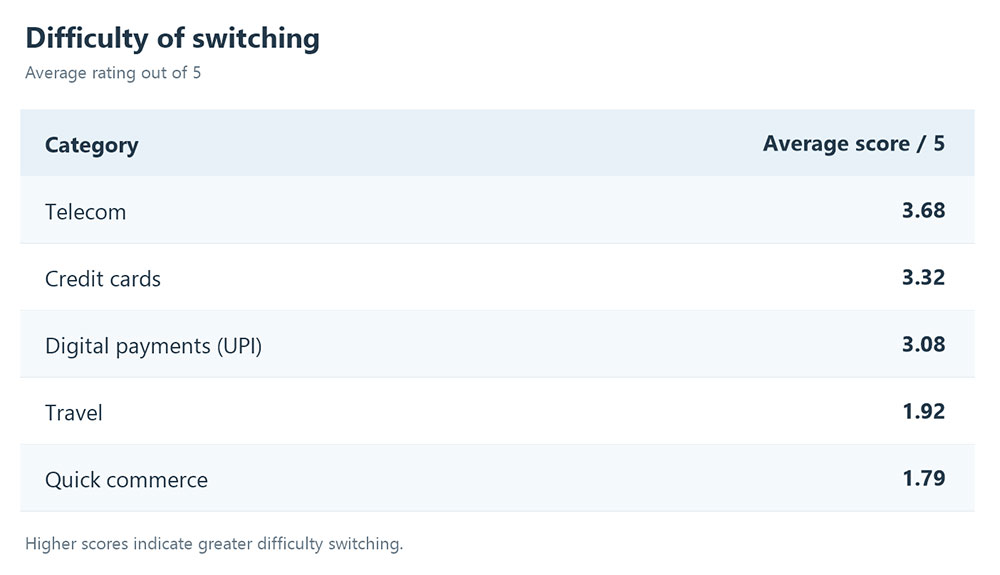
Source: author’s consumer survey, India. Higher scores mean customers find it harder to switch.
Telecom tops the list. That looks reassuring for operators, but it deserves a closer look.
Much of telecom’s stickiness comes from friction: KYC requirements, contracts, bundled devices, and the effort of changing a number that is tied to banking, messaging, and identity. Friction keeps customers in place, but it is not the same as wanting to stay.
Loyalty is attitudinal: how a customer feels about a brand. Stickiness is behavioral: how they actually use it over time. A customer can be highly sticky and only lightly loyal.
That distinction matters more each year. Digital onboarding, eSIM and simpler number porting are steadily lowering the effort of switching. As friction falls, stickiness built on friction falls with it. What remains is the loyalty a provider has actually earned.
At the other end of the scale, quick commerce and travel are highly transactional: whoever offers the best mix of price, convenience, and availability tends to win the next order. Digital payments sit in between. Habit is powerful there, but tolerance for failure is very low.
Churn has quietly changed shape
In most of these categories, customers don’t choose one provider. They use several. Payment users commonly keep two, three, or even four apps installed. In many markets, mobile users carry a second SIM.
This multi-homing changes what churn looks like. Customers rarely leave in one decisive step. More often, they keep the app installed or the SIM active but gradually move their usage elsewhere: fewer transactions, smaller top-ups, the other SIM used for data.
Churn is no longer only about losing customers. It is about losing share of usage.
The real prize, then, is the default position: the app a customer opens without thinking, the SIM they reach for first. Winning the download or the activation is only the beginning.
What customers actually reward
Among payment app users surveyed, the reasons for preferring their primary app were striking:
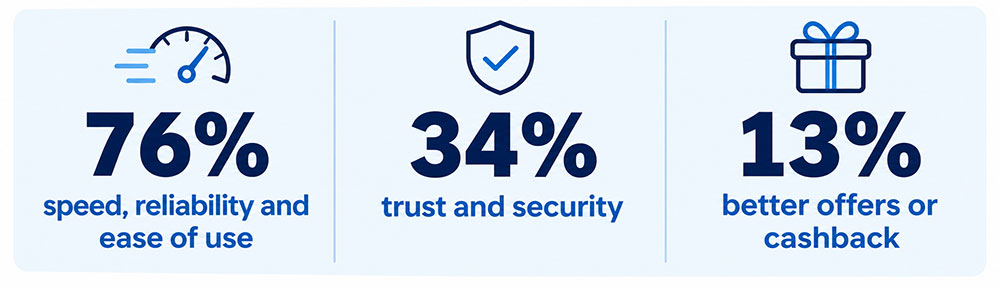
Share of respondents citing each reason; respondents could choose more than one.
Across all five categories, the strongest drivers of stickiness were ease of use, reliability, trust and perceived security, habit, and ecosystem integration. Cashback featured far less than many businesses would expect.
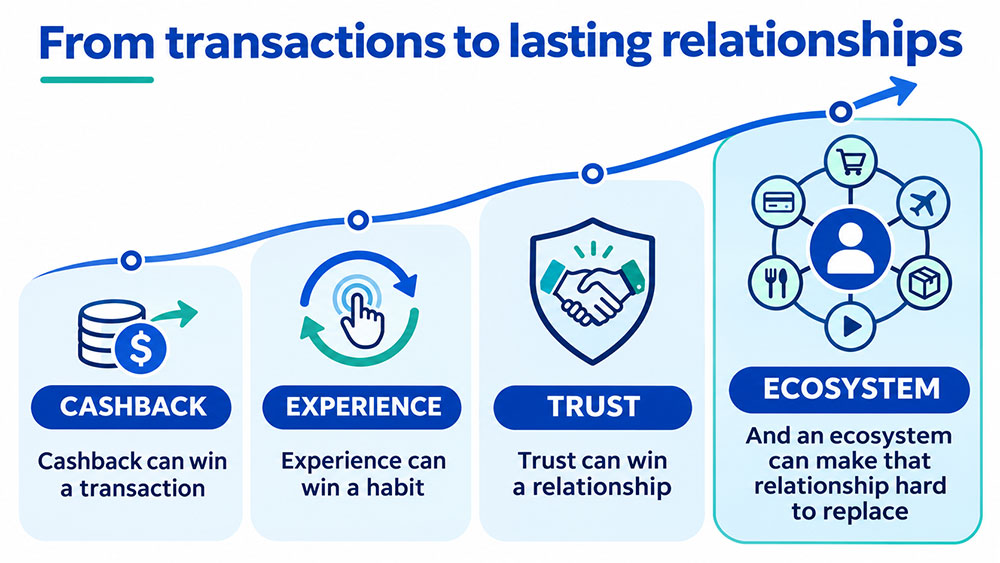
In everyday digital interactions, customers value a predictable, frictionless experience over small savings. Cashback may prompt a transaction. Reliability builds a habit. Trust turns that habit into preference.
Why incentive-led loyalty falls short
Rewards work. The problem is that rewards on their own don’t work well enough, for four reasons:
- They are easy to copy. A competitor can match or beat a discount within days.
- Multi-homing dilutes them. Customers collect offers from several providers without committing to any.
- They don’t differentiate. When a service feels like a utility, a bigger bonus rarely changes how a customer feels about the brand.
- They can attract the wrong customers. Discount-led acquisition draws in the most price-sensitive users, who leave as soon as a better offer appears, and erodes margin along the way.
The four levers of lasting loyalty
Some of the stickiest consumer brands, including Amazon Prime, Apple, American Express and Netflix, operate in very different markets but share a pattern. Customers don’t just use them; they become used to them. Their loyalty draws on several sources of value at once, which can be described as four levers.
1. Economic: fair value and smart rewards
Incentives still matter, but they work best when aimed at behaviors that deepen engagement rather than handed out as blanket discounts. Treat rewards as the entry ticket, not the destination.
2. Experiential: reliable, frictionless journeys
For services used every day, reliability is not a hygiene factor. It is part of the value proposition. One failed payment, a confusing journey, or a poorly handled complaint can undo months of goodwill.
3. Ecosystem: embedded utility
The more a service is woven into a customer’s routines and adjacent needs, the harder it is to replace, not because of a contract, but because it is useful.
4. Emotional: trust, security and recognition
Where money, identity, or personal data are involved, trust becomes decisive. Customers want to know the service works, and that they can rely on it when something goes wrong. Recognition, being known and valued as a customer, turns functional usage into preference.
What the four levers look like for a mobile operator
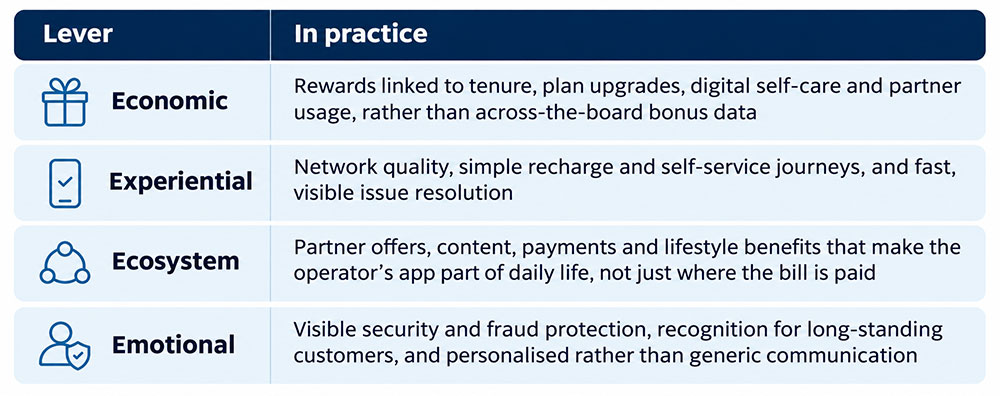
Apple illustrates the point well. It runs no cashback or points program, yet it enjoys exceptional customer stickiness, built almost entirely on experience, ecosystem and emotional connection. Many digital businesses show the opposite pattern: heavy spending on offers, with limited ecosystem depth or emotional differentiation. The result is high usage without real attachment.
No business needs to lead on all four levers. But it needs enough of them working together to make switching feel unnecessary.
One program won’t fit every customer
Customers respond to these levers differently. Three broad behavior patterns stood out:
- Deal-seekers switch often and respond mainly to economic incentives.
- Routine users stay out of habit and convenience. Experience and ecosystem matter most to them.
- Believers feel a real attachment to the brand. Emotional and ecosystem value carry the most weight.
A single, uniform program will over-reward some customers and under-serve others. The next generation of loyalty will be contextual and personalized: the right lever, for the right customer, at the right moment.
From loyalty campaigns to loyalty systems
All of this points to a different question. Instead of asking “How do we offer better discounts?”, the more useful question is:
“How do we become the customer’s default choice?”
Marketing alone can’t answer that. Loyalty becomes a capability across the business:
- Product design that makes the core journey reliable and effortless
- Customer experience that resolves problems quickly and visibly
- Partnerships that extend the service into adjacent needs
- Data and personalization that match the right lever to the right customer
- Trust and brand that give customers a reason to believe
When these work together, loyalty stops being a promotional layer and becomes part of how the business runs.
The goal is the relationship
Loyalty hasn’t disappeared in commoditized digital markets. It has evolved. Customers use multiple providers, but they still form preferences, and last week’s biggest discount rarely shapes them.
At Evolving Systems, we work with mobile operators worldwide on this shift: moving from one-size-fits-all offers to personalized loyalty, gamified engagement, and partner ecosystems that give customers a reason to stay. If you’re rethinking how your business builds loyalty, we’d be glad to continue the conversation.

Sumit Sureka
Solution Consultant at Evolving Systems
Author’s Profile
Sumit Sureka is a Solution Consultant and Product Manager at Evolving Systems with over 18 years of experience driving innovation across telecom and Customer Value Management (CVM) platforms. He specializes in enabling AI-driven CVM, leveraging predictive intelligence, real-time insights, and automation to help operators personalize customer engagement, optimize loyalty programs, and improve customer lifetime value at scale. Sumit has led end-to-end product development initiatives, building solutions that connect subscribers, merchants, and digital ecosystems while addressing complex operational and performance challenges. With hands-on experience supporting telecom operators across South Asia, the Middle East, North America, and CALA, he brings a strong global perspective on applying AI to transform customer engagement strategies. He holds an MBA from SPJIMR, Mumbai, with a focus on IT, Strategy, and Marketing, further strengthening his ability to bridge technology innovation with measurable business outcomes.