
The LATAM Numbering Crunch: How Pre-Provisioning Workflows Built an Artificial Scarcity Crisis
AI-Powered Key Takeaways


Introduction: The Invisible Exhaustion of Telecom Assets
For decades, telecommunications resources like MSISDNs (phone numbers), IMSIs (subscriber identities), and ICCIDs (SIM card identifiers) were treated by Operators as functional, virtually infinite logic blocks. However, the explosion of the Internet of Things (IoT) encompassing smart meters, fleet logistics, connected cars, and sweeping smart city deployments has fundamentally warped consumption dynamics.
Unlike consumer smartphones, which exhibit predictable churn and human-scale growth, an industrial IoT rollout can consume tens of thousands of identifiers in a single day. Across Latin America (LATAM), this IoT era has triggered an unprecedented scarcity crisis, turning identifier allocation into a fierce regulatory battleground.
1. The Regulatory Counteroffensive in LATAM
As we move through 2026, regional regulators including Anatel (Brazil), IFT (Mexico), CRC (Colombia), and Subtel (Chile) are drastically changing their positioning. Historically lenient with block assignments, regulators are now systematically rejecting expansion requests from Mobile Network Operators (MNOs) and Mobile Virtual Network Operators (MVNOs).
Why Regulators are Rejecting Requests
- The “Hoarding” Problem: MNOs routinely request massive blocks (e.g., millions of MSISDNs/IMSIs at a time) to anticipate future sales pipelines, leaving massive percentages of these resources sitting idle.
- Forced Optimization Mandates: Regulators are shifting the burden of proof back to the telcos. Compliance audits demand that operators demonstrate an active utilization rate (often upwards of 80–85%) of their existing assigned blocks before a single new digit is allocated.
- The MVNO Squeeze: MVNOs, which scale rapidly but often unevenly across niche B2B IoT markets, are suffering the most. Regulators are restricting host MNOs from sub-leasing identifiers to MVNOs unless rigorous, real-time efficiency metrics are produced.
2. The Hidden Catalyst: The Cost of Legacy Pre-Provisioning
While the sheer volume of IoT devices is a major factor, the acute exhaustion of MSISDN, IMSI, and ICCID blocks is primarily driven by an internal operational failure: the legacy pre-provisioning process.
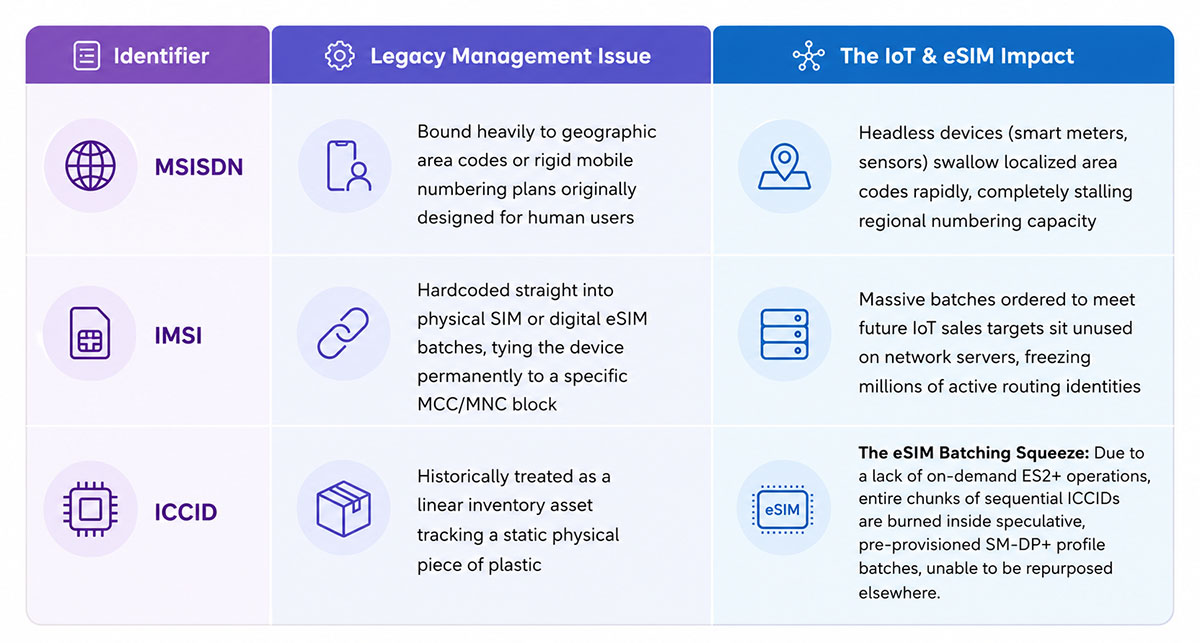
Historically, MNOs and MVNOs have operated on a predictive warehouse model. When ordering physical SIM cards, operators pre-allocate and hardcode network resources directly onto the plastic months before they reach a customer.
More critically, this legacy mindset has infected the modern eSIM (eUICC) ecosystem. In a fully optimized digital architecture, eSIM profiles should be created on-demand. However, many operators still lack full operational maturity over the ES2+ interface the standard GSMA interface connecting the Operator’s BSS/CRM to the SM-DP+ (Subscription Manager Data Preparation) node.
Because operators cannot trigger real-time profile creation and allocation via ES2+ APIs, they are forced to rely on batch processing.

This creates a devastating operational and financial bottleneck:
- The “Dead Space” Exhaustion: Millions of numbers are locked into SIMs sitting on warehouse shelves, packaged in retail blister packs, or embedded in un-assembled connected cars. They are legally “consumed” from the regulator’s perspective, but completely dark on the network.
- The Financial Drain: In many LATAM jurisdictions (such as Brazil, where regulatory fees heavily penalize active or allocated lines), operators find themselves paying recurring taxes or licensing maintenance fees to regulators for identifiers that have not generated a single cent of revenue and may not for months or years.
- The Regulatory Shield: When operators approach regulators for new numbering blocks because their inventory is running low, the regulators look at the raw utilization data. They see millions of allocated but entirely inactive numbers. Defending their national numbering plans, regulators point to the exploding demand of the IoT/M2M era and flatly reject the requests, telling operators to clean up their house before asking for more.
3. The Core Technical Bottlenecks
To articulate the crisis clearly, we must look at the three distinct architectural pain points:
4. The Solution: Intelligent Automation & Resource Orchestration
To pass regulatory audits and survive this structural squeeze, operators can no longer rely on legacy ERP systems or manual spreadsheet tracking. They must transition to automated, programmatic Resource Lifecycle Management platforms characterized by three pillars:
4.1 The Engine: Dynamic SIM Allocation (DSA) Across All Channels
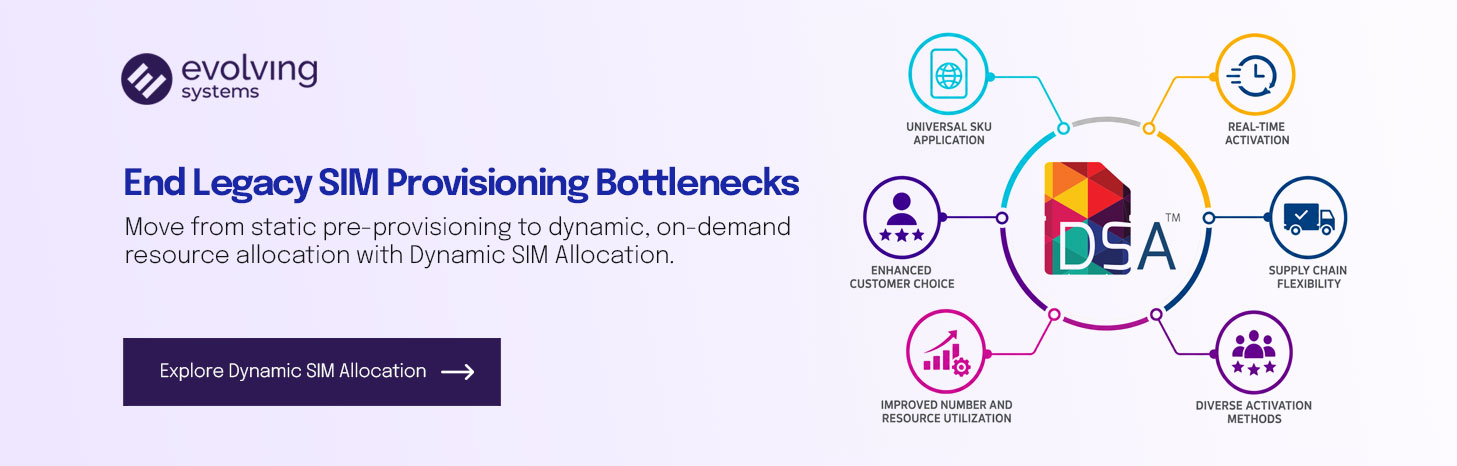
The absolute centerpiece of this architectural overhaul is the deployment of a centralized Dynamic SIM Allocation (DSA) platform. Instead of tying specific identifiers to specific sales vectors during manufacturing, the DSA acts as an abstract orchestration layer between the raw resource pools and the fulfillment infrastructure.
Whether an entry vector originates from physical retail SIM cards, digital eSIM QR codes, bulk B2B enterprise orders, or wholesale MVNO connections, the DSA unifies the provisioning experience. It distributes resources dynamically towards any channel on-demand. A physical SIM card in a retail store or a blank profile on an SM-DP+ remains entirely sterile holding nothing but a placeholder or bootstrap profile until a client interaction occurs.
4.2 Real-Time ES2+ Integration & Just-In-Time (JIT) Activation
By pairing the DSA with real-time ES2+ interface integration, operators can break the pre-provisioning cycle entirely. Instead of ordering batches of 100,000 eSIM profiles from the SM-DP+, the operator’s automation engine triggers an ES2+ DownloadOrder only when an end-user or IoT device actively requests a profile.
The valuable production MSISDN and production IMSI are pulled from the regulator-allocated pool by the DSA at the exact second the device undergoes its “First Boot” or registration on the network. This completely eliminates “dark inventory” on the SM-DP+ and avoids premature regulatory taxes on dead stock.
4.3. Resource Segmentation (Decoupling and Slicing)
Operators must break down massive, monolithic identifier pools into highly granular, logical segments. By segregating human voice/data traffic from headless M2M (Machine-to-Machine) traffic, operators can apply specialized, non-geographic national numbering plans (such as dedicated 12 or 14-digit IoT numbering blocks authorized by regulators) specifically to IoT devices, preserving highly valued 9 or 10-digit human numbers.
4.4. Hierarchical State Management & Instant Recycling
Establishing a strict multi-tenant, hierarchical matrix allows an MNO to dynamically provision and reclaim assets from its sub-brands and wholesale MVNO partners. Furthermore, advanced state management introduces dynamic and distinct lifecycle transitions depending on channels, number type, segment and so on:

Legacy telco systems often place deactivated numbers into quarantine for 6 to 12 months before they can be reused. In the IoT era, this lag is lethal. For devices that do not receive incoming SMS or voice calls (like smart agriculture sensors), state management engines can bypass long quarantine states entirely, safely recycling the MSISDN or internal routing identifier back to the central pool within days of decommissioning.
Conclusion: Turning a Crisis into an Efficiency Dividend
The strict stance taken by LATAM regulators is a forced evolution. While it presents a tough operational hurdle in the short term, operators that break the pre-provisioning cycle and embrace automation, precise resource segmentation, and aggressive state management will build leaner, more profitable architectures. Ultimately, a better utilized network resource footprint doesn’t just satisfy the regulator it directly lowers operational expenditures, cuts premature tax leaks, and maximizes the return on network assets.
Bibliographic Framework & Industry References
- Agência Nacional de Telecomunicações (Anatel – Brazil): Resolução nº 735/2020 (Regulamento de IoT e M2M). Established the reduction of regulatory barriers for machine-to-machine ecosystems and initiated the decoupling of consumer voice resources from pure telemetry profiles.
- Anatel Public Consultations (Consulta Pública nº 39/2019 & nº 41): Detailed audits on numbering allocation, exposing structural “hoarding” habits by dominant carriers and laying out frameworks for resource optimization.
- GSMA Official Specifications: GSMA eSIM Remote Provisioning Architecture (SGP.02 / SGP.22). Defines the standard implementation rules for the ES2+ interface protocol running between BSS entities and the SM-DP+, highlighting the paradigm shift toward real-time profile delivery.
- International Numbering Shifts (The 2026 Trend): Similar numbering overhauls (e.g., Spain’s National Numbering Plan updates for July 2026 enforcing dedicated 13-digit lines with specific prefixes like ’59’ for M2M communication) demonstrate the exact global regulatory blueprint currently squeezing LATAM telecom networks.
About the Author
Roberto Rodriguez, Solution Consultant at Evolving Systems
Roberto Rodriguez is a telecommunications engineer holding an M.Sc. in Electronic Engineering from UERJ and an Executive MBA from COPPEAD/UFRJ with 26 years of experience in mission-critical carrier infrastructure, mobile-core network engineering, and IoT/eSIM connectivity platforms. Over the course of his career, he has led deployment and solution design engagements with several of the largest telecom vendors globally, including Nokia and Huawei, delivering carrier-grade network and IoT solutions for Tier-1 operators.
He currently leads presales and solution consulting across Central and Latin America for Evolving Systems, owning technical win strategy for RFPs, RFIs, and RFQs on complex, multi-million-dollar enterprise telecom deals. He architects end-to-end solutions, cost structures, and staffing models, partnering with sales to convert customer requirements into won, committed business, and owns customer relationships from proposal through delivery and live account management, driving renewals and expansion across multiple accounts.