
A Smarter SIM Strategy for Africa’s Next Phase of Growth
For many years, Dynamic SIM Allocation (DSA) has been viewed as an operational tool.
AI-Powered Key Takeaways


Its role was straightforward: simplify SIM inventory, improve numbering efficiency, and reduce the cost of managing large-scale distribution networks.
That value is constant. But telco markets are changing.
Across Africa, telecom operators are competing in a market where subscriber expectations are rising, acquisition channels are evolving, and digital services are increasingly contributing to revenue growth.
In such an environment, the goal is not only to manage SIM resources efficiently but also to make activation flexible enough to support the operator’s commercial strategy.
That shift is giving Dynamic SIM Allocation a much broader role.
Rather than simply improving operational efficiency, it is now becoming a part of how operators accelerate acquisition, personalize customer experiences, and build more agile distribution models.
Growth Is Creating New Operational Pressure
African telecom markets are evolving rapidly.
- Subscriber bases are expanding.
- Mobile money ecosystems continue to grow.
- Digital onboarding is becoming more common.
- New partnerships, enterprise services, and connected-device deployments are adding complexity.
At the same time, operators are under pressure to improve returns on every investment.
Unused SIM inventory, fragmented numbering resources, and inefficient distribution processes tie up capital without creating value. These inefficiencies have existed for years, but their commercial impact is now clearer.
Markets are moving faster, product cycles are becoming shorter, and customer expectations are rising steadily.
This makes operational flexibility as important as network capability.
Static Provisioning Is Becoming a Constraint
Traditional SIM provisioning was built around predictability.
SIMs were pre-configured before distribution, with subscriber identities, number ranges, and service profiles assigned long before they reached the customer.
That model worked well when acquisition came from relatively stable retail channels, but today’s subscriber environment looks very different.
Customers can purchase services through retail stores, digital channels, self-service apps, mobile money agents, enterprise partners, or temporary campaigns. Demand shifts quickly across regions and channels, making it hard to predict where SIM inventory will be needed next.
This complexity comes from telco growth.
Operators often balance excess inventory in one location against shortages in another. Numbering resources fragment, logistics costs rise, and activation flexibility shrinks just when speed matters most to customers.
These are no longer mere operational issues. They directly influence acquisition performance and commercial execution.
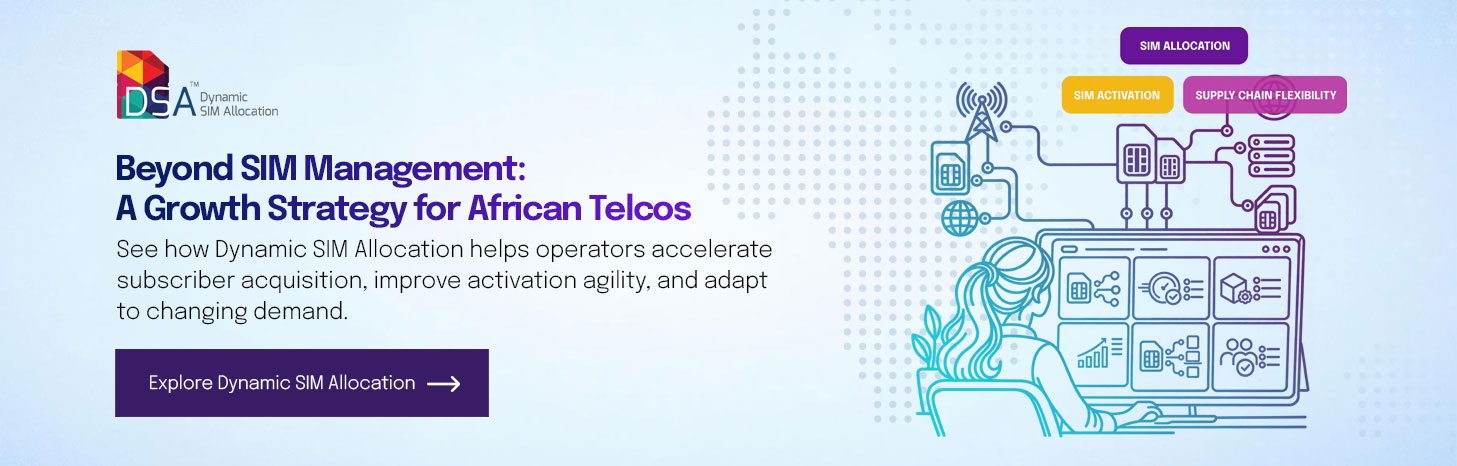
From Operational Efficiency to Commercial Agility
Dynamic SIM Allocation changes this model.
Instead of assigning subscriber identities and numbering resources before distribution, operators can allocate them only when the SIM is activated, creating a more responsive acquisition environment.
Universal SIM inventory can support multiple channels. Operators assign resources based on actual demand rather than forecasts. Inventory becomes easier to manage. As a result, operators gain greater flexibility as market conditions change.
The value extends well beyond logistics.
As telcos continue to introduce new offers and digital services, activation becomes less of a constraint and more of a business enabler.
Personalization Starts Earlier Than Many Operators Think
The telecom industry has spent years investing in customer-centricity.
Personalized offers, AI-driven recommendations, and contextual engagement are becoming standard parts of customer value management.
Yet personalization should begin long before the first marketing campaign. It should begin the moment a subscriber joins the network.
Dynamic activation lets operators assign subscriber identities, service profiles, and numbering resources in real time, creating a flexible foundation for personalized onboarding. They can align activation with the subscriber’s chosen language, acquisition channel, or service package from the start.
That first interaction shapes customer perception.
A seamless activation experience increases confidence in the operator, while delays and friction create churn risks at the earliest stage of the customer relationship.
As digital acquisition continues to grow across African markets, that first-use experience should become an important part of the customer experience strategy.
Supporting Efficiency and Sustainability Together
For many telcos, operational efficiency and sustainability are closely connected priorities.
Reducing excess inventory, minimizing logistics, and improving resource utilization help lower costs while reducing waste across the supply chain.
Dynamic SIM Allocation supports both objectives.
By allocating resources only when demand exists, operators can reduce dormant inventory, improve numbering utilization, and simplify inventory planning across markets.
This creates measurable savings while supporting broader sustainability goals.
Building the Activation Model for Africa’s Next Phase of Growth
Dynamic SIM Allocation is not a new technology. But today, its relevance is growing because the telecom operating model has changed.
As eSIM adoption expands, digital onboarding grows, and AI shapes the customer lifecycle, operators need activation platforms that can support continuous innovation.
Dynamic SIM Allocation serves exactly that purpose. By letting operators allocate subscriber identities and numbering resources dynamically, the platform simplifies inventory management, improves activation agility, and supports personalized subscriber onboarding across retail, digital, and partner channels.
Having the largest SIM inventory is no longer a prerequisite for market leadership. Instead, profitable, scalable growth requires the ability to activate subscribers faster, adapt to changing demand more easily, and deliver a better first experience for customers.
This is the support that African telecom operators currently need.
Continuing the Conversation at Africa Tech Festival 2026
Adapting to this shifting landscape requires a proactive approach to technology and strategy. That’s why these operational challenges, resource efficiencies, and growth strategies will be the central focus of our conversations as we head to Africa Tech Festival 2026 in Cape Town later this year.
The event brings together the region’s industry pioneers, and our global telecom experts are looking forward to diving deep into how frameworks like Dynamic SIM Allocation (DSA) can practically advance your commercial execution.
Let’s connect to discuss how you can optimize your retail channels, streamline digital onboarding, and build a highly responsive activation model for your network. Book a 1-on-1 meeting with our executive team at Africa Tech Festival 2026.