
From Cashback to Commitment: Rethinking Customer Loyalty in Digital Platforms
AI-Powered Key Takeaways


Customer loyalty in digital markets is often misunderstood as discounts and cashback. However, research across fintech, telecom, credit cards, quick commerce, and travel platforms shows that long-term stickiness is driven more by experience reliability, ecosystem integration, and trust. This article introduces a practical four-lever framework to design loyalty beyond incentives.
In today’s digital economy, loyalty is often mistaken for discounts.
Telecom operators offer extra data packs. Fintech apps provide cashback. Quick commerce platforms compete on coupons. Travel apps flood users with promotional notifications. Yet, despite these incentives, customers continue to use multiple apps, switch frequently, or quietly reduce engagement.
This raises a fundamental question:
If companies are investing heavily in loyalty programs, why does true loyalty still seem fragile?
As part of my Independent Industry Learning Project (IILP) at SPJIMR, I explored this question across five digital-first industries:
- Telecom
- Fintech (UPI and wallets)
- Credit cards
- Quick commerce
- Travel-commerce
The objective was to understand what truly drives customer stickiness in markets where products feel increasingly similar and switching is easier than ever.
The Loyalty Paradox in Digital Markets
Many digital categories today operate in highly commoditized environments.
From a customer perspective:
- Most apps offer similar features
- Prices are often comparable
- Switching costs are low
- Multiple apps can be installed and used simultaneously
As a result, multi-homing has become the norm.
Customers do not necessarily leave one platform completely. Instead, they distribute their usage across multiple providers, choosing whichever offers the best value at a given moment.
This creates a subtle but important shift:
Churn is no longer just about customers leaving. It is about declining share of usage.
Not All Stickiness Is Created Equal
One of the more interesting findings from the research was how differently stickiness manifests across industries. When respondents rated how difficult it feels to switch providers, a clear hierarchy emerged:
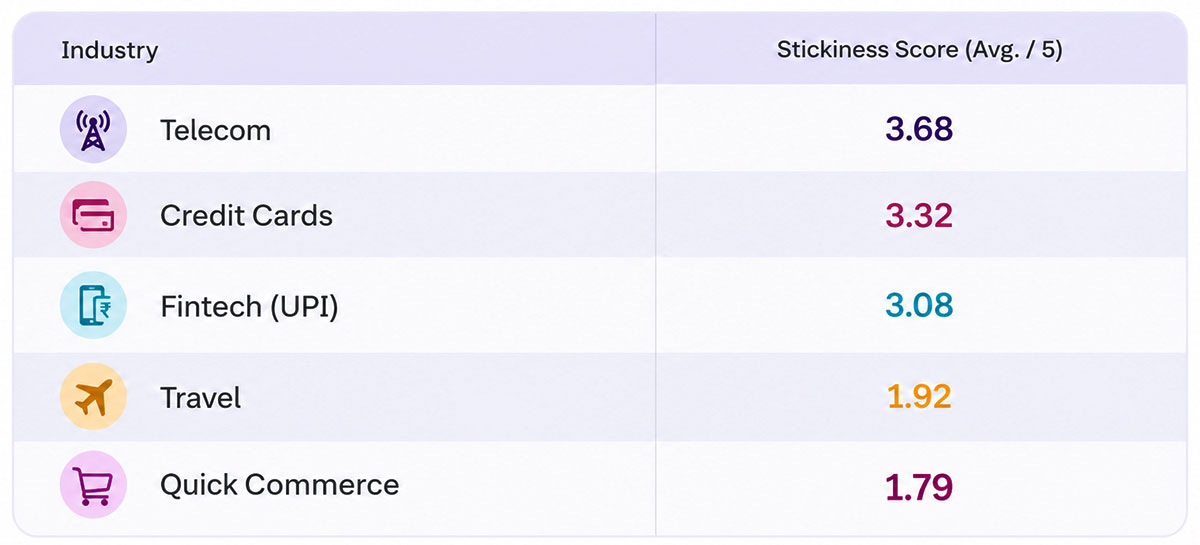
The catch? Higher stickiness often reflects friction, not affection.
Telecom and credit cards score relatively higher largely because of KYC hurdles, contracts, and switching friction, not because customers feel emotionally connected to their provider.
Quick commerce and travel, on the other hand, are highly transactional environments. The provider offering the best combination of price and convenience often wins the order.
Fintech sits in the middle, a battleground category where habit becomes the primary glue, and the margin for error is extremely small.
What the Research Found
The study combined a consumer survey, secondary research from consulting firms and academic literature, and benchmarking of high-stickiness platforms such as Amazon Prime, Apple, AMEX, and Netflix.
One insight stood out clearly: Customers rarely remain loyal because of cashback alone.
When fintech users were asked why they prefer their primary payment app:
- 76% cited speed, reliability, and ease of use
- 34% cited trust and security
- Only 13% cited better offers or cashback
Across industries, the strongest drivers of stickiness were:
- Ease of use
- Reliability
- Trust and perceived security
- Habit formation
- Ecosystem integration
The fact that experience outranks value is an important insight. In high-frequency digital use cases, customers are often willing to forgo marginal financial savings in exchange for frictionless and predictable interactions.
Cashback and rewards help attract users but rarely sustain long-term preference.
In many digital contexts, reliability itself becomes the loyalty program.
Loyalty vs Stickiness: An Important Distinction
The research distinguishes between two related but different concepts:
- Loyalty is attitudinal: how customers feel about a brand.
- Stickiness is behavioral: how customers actually use a product over time.
A customer may like multiple apps but still rely on one as their default.
This is particularly visible in fintech:
Most users have 2 – 4 payment apps installed but typically rely on one primary app for daily transactions.
Winning the default slot, not just the download is the real prize.
Why Traditional Loyalty Programs Often Fail
Many loyalty programs focus heavily on monetary incentives:
- cashback
- points
- discounts
- limited time offers
These tactics can increase short-term engagement but often fail to build durable relationships.
Four structural challenges emerge:
- Offers are easily replicable: Any incentive introduced by one platform can be matched or exceeded, by competitors relatively quickly
- Multi-homing weakens exclusivity: Any incentive introduced by one platform can be matched or exceeded by competitors relatively quickly.
- Emotional connection remains weak: Most digital apps are experienced as utilities rather than brands – useful, but rarely distinctive. Survey responses frequently included statements such as: “all apps feel the same” and “nothing is unique“.
- Incentive leakage reduces profitability: Discount-led strategies often attract price-sensitive users who may not deliver long-term value.
The problem is not that rewards don’t work. It is that rewards alone don’t work enough.
Learning from High-Stickiness Ecosystems
Some companies have successfully moved beyond transactional loyalty.
Amazon Prime, Apple, and AMEX demonstrate how loyalty can be designed as a system rather than a campaign.
Despite operating in very different industries, they share one thing in common: Customers do not just use them, they depend on them.
That is not accidental.
These companies are not simply running better discount programs; they are designing loyalty structurally differently.
They combine multiple dimensions of value:
- strong product experience
- ecosystem integration
- trust and brand credibility
- selective rewards
The result is not just repeat usage, but preference.
Customers stay not because they are locked in, but because leaving feels inconvenient or unnecessary.
The Four-Lever Loyalty Playbook
Based on the research findings and existing academic literature, I synthesized a simple four-lever framework to explain how loyalty translates into customer stickiness.
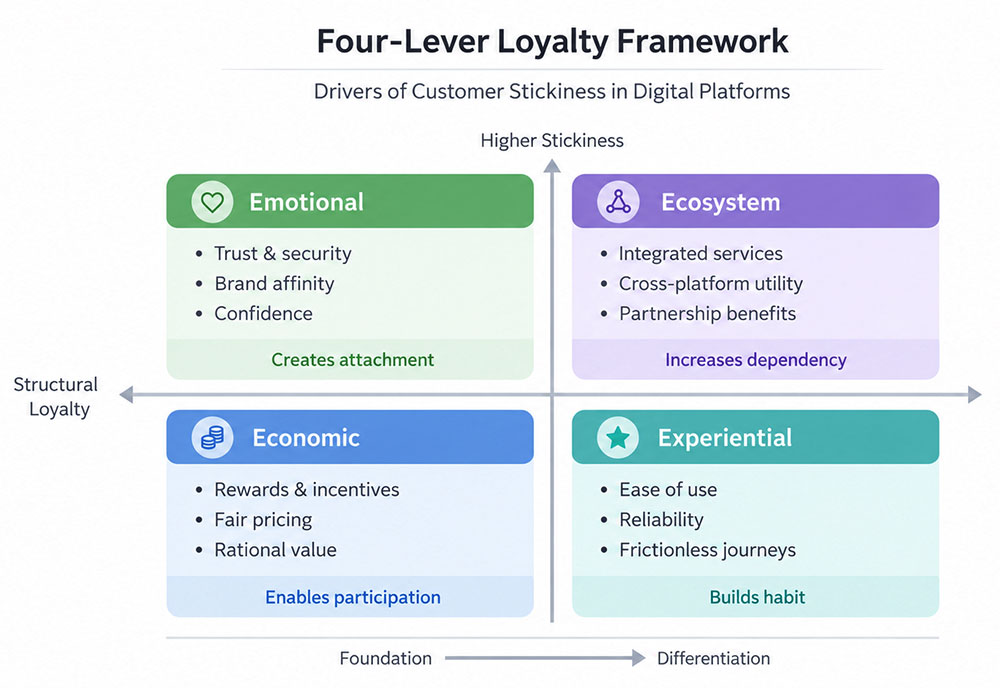
Fig 1: Four-Lever Loyalty Framework
True loyalty emerges from the interaction of four drivers:
1. Economic – Fair Value, Smart Rewards
Financial incentives matter, but they should be behavior-linked, tied to actions that genuinely increase retention and usage depth, rather than blanket discounts that subsidize opportunistic switching.
Think of incentives as the entry ticket, not the destination
2. Experiential – Frictionless, Intuitive Journeys
Service quality and reliability are primary loyalty drivers, not hygiene factors.
In fintech, particularly, a single failed transaction or poorly resolved dispute can trigger immediate disengagement.
Zero-fail performance is not a differentiator; it is the loyalty proposition.
3. Ecosystem – Embedded Utility
The deeper a platform embeds itself into a customer’s daily routines and adjacent needs, the harder it becomes to replace, not through contractual lock-in, but through genuine relevance.
This is how platforms such as Amazon and Apple create switching costs without formal contracts.
4. Emotional – Trust, Security and Recognition
Emotional reassurance is particularly critical in financial services, where anxiety around money, privacy, and fraud is always present.
Visible trust signals, strong protection mechanisms, and recognition of loyal users can turn functional use into long-term preference.
The strongest loyalty outcomes occur when multiple levers operate simultaneously.
The Four-Lever Loyalty Playbook synthesizes insights from multiple research streams covering customer experience, behavioral loyalty, and platform ecosystems. Prior literature highlights the importance of experiential interactions and emotional engagement in shaping loyalty outcomes, while ecosystem integration increases switching costs and strengthens platform dependence (Asyhari & Dermawan, 2024; Jacobides, Cennamo & Gawer, 2018; McKinsey, 2023).
Applying the Framework: How High-Stickiness Brands Compare
If the framework holds true, highly sticky brands should demonstrate strength across multiple levers.
The contrast with a typical fintech UPI app is revealing:
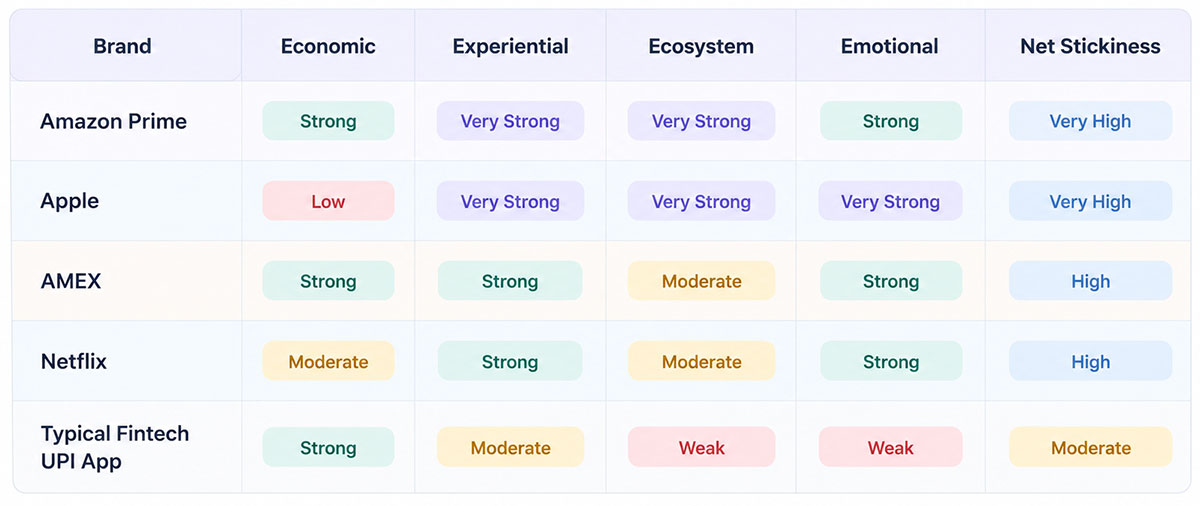
Apple provides an interesting illustration.
It scores relatively low on Economic levers; there is no cashback or points program, yet it remains one of the stickiest brands globally.
This is largely because it performs strongly on Experiential, Ecosystem, and Emotional dimensions simultaneously.
Many fintech apps exhibit the opposite pattern: heavy investment in cashback and offers but limited ecosystem depth and weaker emotional differentiation.
The result is high usage but relatively shallow attachment.
The broader insight is important:
Companies do not need to dominate all four levers, but they must activate enough levers in combination to make switching feel unnecessary.
Not Every Customer Is the Same
Customers are not homogeneous in how they respond to loyalty mechanisms.
Three broad segments emerge:
- Deal-Seekers: Switch frequently based on offers and respond primarily to Economic incentives.
- Routine Users: Stay with one provider largely due to habits and experience. Experiential and Ecosystem levers are particularly important here.
- Believers: Demonstrate strong attachment to a brand. Emotional and Ecosystem levers matter most for this segment.
A one-size-fits-all loyalty program inevitably underserves at least two of these segments.
Fintech as a Case Study
Fintech platforms operating on UPI provide an especially interesting context.
Transaction fees are minimal or zero, and most apps offer broadly similar functionality.
Yet users still exhibit clear preference patterns.
The research suggests that fintech loyalty depends disproportionately on:
- trust
- reliability
- ease of use
- acceptance across merchants
- habit formation
Many users indicated they would remain loyal if platforms offered:
- stronger security assurances
- better dispute resolution mechanisms
- meaningful ecosystem benefits
- more personalized rewards
This suggests that the next phase of fintech loyalty innovation may focus less on cashback and more on:
- trust-enhancing features
- integrated financial ecosystems
- experience reliability as a core differentiator
Implications for Product and Strategy Teams
The findings suggest a shift in how loyalty should be designed:
Instead of asking:
How do we offer better discounts?
Companies may need to ask:
How do we become the default choice?
For fintech firms operating in India’s zero-MDR environment, where transaction-level monetization is constrained, this question is particularly important.
Long-term profitability depends on retention, usage depth, and cross-sell.
Loyalty therefore cannot be treated purely as a marketing activity.
It becomes a system-level capability requiring coordination across:
- product design
- customer experience
- ecosystem partnerships
- analytics and personalization
- trust and brand positioning
Closing Thoughts
In commoditized digital markets, loyalty does not disappear.
It evolves.
Customers may use multiple apps, but they still prefer one experience over another, and that preference is rarely determined by who offered the biggest discount last week.
The companies that succeed long-term are those that become part of everyday habits, reliable, trusted, and embedded in how customers manage their money, time, and decisions.
The goal is not just the transaction. It is the relationship

Sumit Sureka
Solution Consultant at Evolving Systems
Author’s Profile
Sumit Sureka is a Solution Consultant and Product Manager at Evolving Systems with over 18 years of experience driving innovation across telecom and Customer Value Management (CVM) platforms. He specializes in enabling AI-driven CVM, leveraging predictive intelligence, real-time insights, and automation to help operators personalize customer engagement, optimize loyalty programs, and improve customer lifetime value at scale. Sumit has led end-to-end product development initiatives, building solutions that connect subscribers, merchants, and digital ecosystems while addressing complex operational and performance challenges. With hands-on experience supporting telecom operators across South Asia, the Middle East, North America, and CALA, he brings a strong global perspective on applying AI to transform customer engagement strategies. He holds an MBA from SPJIMR, Mumbai, with a focus on IT, Strategy, and Marketing, further strengthening his ability to bridge technology innovation with measurable business outcomes.