
Dynamic SIM Allocation and eSIM: Building a More Flexible Connectivity Model
AI-Powered Key Takeaways


eSIM is changing how connectivity is provisioned and managed.
As operators expand digital onboarding, connected device programs, enterprise mobility, and IoT deployments, the traditional relationship between a SIM, its assigned resources, and the point of activation is becoming less fixed.
But removing the physical SIM card does not remove the need to manage identities, profiles, numbers, policies, activation workflows, and network resources efficiently. In many cases, digital connectivity introduces a new layer of operational complexity that still needs to be coordinated at scale.
This is where Dynamic SIM Allocation (DSA) and eSIM orchestration can work together.
eSIM provides the flexibility to provision and manage connectivity profiles remotely. Dynamic SIM Allocation helps operators assign the appropriate subscriber, numbering, and service resources closer to the point when they are actually needed.
Together, they support a more responsive approach to connectivity management, helping operators move away from rigid, pre-assigned models and align activation more closely with real subscriber and device demand.
eSIM Changes Delivery. Dynamic Allocation Changes Resource Management.
Traditional SIM operations typically involve manufacturing, provisioning, distribution, and management of physical SIM inventory before a subscriber or device connects.
eSIM changes an important part of that process.
Instead of physically replacing a SIM card, operators can remotely provision and manage profiles on an embedded or integrated SIM-capable device.
That creates significant opportunities for:
- Digital subscriber onboarding
- Connected vehicles
- Enterprise mobility
- IoT and M2M deployments
- Remote device provisioning
- Global connectivity services
But digitizing SIM delivery does not automatically solve the underlying resource-management challenge.
Operators still need to determine:
- Which profile should be provisioned?
- Which IMSI or subscriber identity should be allocated?
- Which MSISDN or number should be assigned?
- Which service or tariff profile applies?
- Which network resources should be activated?
- When should those resources be allocated?
- How should they be managed throughout the lifecycle?
This is where the distinction matters:
eSIM enables remote profile delivery. Dynamic allocation enables the right profile based on subscriber type, device model, service model, and technology restrictions (3G/4G/5G/Nb-IoT). It helps ensure that connectivity and numbering resources are assigned when and where they are actually needed.
Why eSIM Alone Does Not Eliminate Provisioning Complexity
Moving from physical SIMs to eSIM can simplify distribution. However, operators can still recreate many of the inefficiencies of traditional SIM provisioning if large numbers of profiles and associated resources are prepared in advance.
An eSIM profile that has already been assigned production resources but has not yet been activated can become another form of unused inventory.
That can leave operators managing:
- Unused eSIM profiles
- Reserved numbering resources
- Pre-allocated subscriber identities
- Multiple profile pools
- Separate workflows across channels
- Increasing operational complexity as deployments scale
DSA addresses the broader provisioning problem by moving resource allocation closer to activation rather than tying those resources permanently to inventory in advance— Positioning DSA around real-time activation, universal inventory strategies, and just-in-time assignment of subscriber resources.
For eSIM environments, the same principle can help operators avoid replacing physical stock complexity with digital profile complexity.
What Does eSIM Orchestration Add?
eSIM orchestration provides the workflows and control needed to coordinate eSIM provisioning throughout the lifecycle.
Depending on the deployment architecture, this can include:
- Requesting or preparing an eSIM profile
- Triggering remote profile download
- Activating or deactivating profiles
- Managing profile status
- Coordinating provisioning workflows
- Supporting device lifecycle changes
- Integrating eSIM processes with BSS, OSS, and subscriber onboarding systems
- Allocate the right profile based on device type (IoT, M2M, Consumer), subscriber type (prepaid/postpaid), technology type (3G/4G/5G/NB-IoT), etc.
For high-volume IoT and enterprise environments, automation becomes particularly important because manually managing individual devices and connectivity profiles quickly becomes impractical.
Evolving Systems positions automated eSIM provisioning, workflow-based activation, and IoT/M2M orchestration as important capabilities within the broader SIM and eSIM lifecycle.
The value is therefore not simply that a profile can be downloaded remotely.
The greater opportunity lies in creating an operating model in which profiles, identities, numbers, and services can be dynamically coordinated as demand arises.
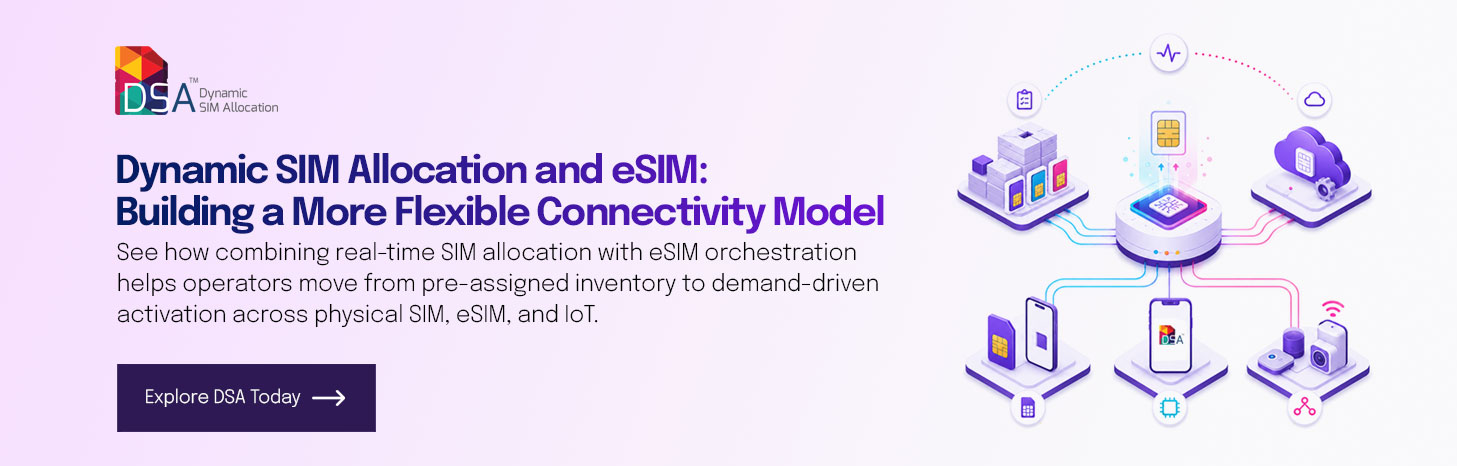
Where Dynamic SIM Allocation Strengthens the Model
Dynamic SIM Allocation adds another layer of intelligence to connectivity management by reducing dependency on pre-assigned resources.
Instead of permanently linking connectivity resources to a SIM or eSIM profile before activation, operators can allocate them when the subscriber or device actually requires service.
This has several important implications.
1. Just-in-Time Resource Allocation
One of DSA’s core strengths is the ability to allocate resources closer to the point of activation.
This can include resources such as:
- IMSIs
- MSISDNs
- Subscriber identities
- Service profiles
- Tariff or product configurations
Allocating these resources when they are required can reduce the amount of numbering and network capacity tied to inactive inventory.
DSA is specifically focused on efficient MSISDN allocation and improved resource utilization, rather than on pre-assigning resources unnecessarily.
For operators managing large numbers of devices or subscribers, this can make resource management considerably more efficient.
2. One Allocation Model Across Physical SIM and eSIM
A major advantage of DSA is that dynamic allocation need not be limited to a single SIM format.
Operators increasingly manage a mix of:
- Physical SIMs
- eSIMs
- Smartphones
- Feature phones
- IoT devices
- Enterprise connections
- 3G and 4G subscribers
- 5G services
A centralized allocation model can help operators apply consistent business rules across these different environments.
This is particularly important while physical SIM and eSIM coexist. Operators do not necessarily need separate resource-allocation strategies for each channel or device type.
Instead, the underlying principle remains the same: Allocate the appropriate resources when actual demand becomes known.
3. Dynamic Product and Service Assignment
DSA does more than assign a subscriber identity.
At activation, operators can determine the appropriate service configuration based on the subscriber, device, channel, or business context.
For consumer services, that might involve:
- Tariff selection
- Language
- Mobile number choice
- Promotional offers
- Prepaid or postpaid configuration
For IoT or enterprise deployments, the same concept can support configuration based on device type, connectivity requirements, or service use cases.
DSA uses this first-use personalization, including real-time tariff, language, number, and service choices.
4. More Efficient Multi-Channel Activation
Subscriber activation increasingly spans physical retail and digital channels.
A customer may activate through:
- A dealer
- Operator retail
- A mobile application
- An e-commerce journey
- Self-service
- An enterprise provisioning process
- An IoT deployment workflow
DSA allows operators to separate connectivity resources from the channel through which the activation originates.
DSA serves as a centralized allocation capability that dynamically distributes resources across physical SIM, digital eSIM, enterprise, and wholesale scenarios. This means inventory and resources can respond to demand rather than being permanently segmented by channel.
Dynamic Connectivity for IoT
The combination becomes particularly interesting for IoT.
An IoT deployment may involve thousands or millions of devices with long operating lifecycles, different connectivity requirements, and deployments spanning multiple regions.
The challenge is therefore not simply downloading an eSIM profile.
Operators also need to coordinate:
- Device activation
- Connectivity identity
- Network access
- Service configuration
- Lifecycle changes
- Resource utilization
Automated eSIM provisioning provides the mechanism for remotely delivering connectivity. DSA can complement this by assigning the appropriate telecom resources when the device begins service. That supports a more scalable model than permanently pre-allocating valuable resources to devices before they become active.
Supporting 3G, 4G, 5G and IoT Environments
Operators continue to manage mixed network environments.
DSA can support operators as they manage existing subscriber bases while introducing newer connectivity models and IoT technologies.
This gives operators a more practical migration path: modernize allocation and activation in line with business requirements without waiting for the entire network or subscriber base to migrate to 5G.
From Digital Provisioning to Smarter Resource Orchestration
The broader opportunity is not simply to digitize SIM provisioning.
It is to rethink when connectivity resources are committed.
Traditional provisioning often works according to forecast demand:
Provision → assign → distribute → wait for activation
Dynamic allocation reverses that logic:
Distribute or make connectivity available → receive demand → allocate → activate
With eSIM, the physical distribution stage can disappear entirely, making the model even more responsive.
An operator can potentially move toward:
Request → allocate → provision → activate
That difference matters. It helps operators align resource consumption more closely with real subscriber and device demand.
Business Benefits of Combining Dynamic Allocation and eSIM Orchestration
For operators, the value extends beyond technical provisioning.
Better Resource Utilization
Resources such as MSISDNs and subscriber identities can be allocated closer to actual activation rather than being held against unused inventory.
Faster Activation
Automated provisioning and real-time allocation can shorten the journey from connectivity request to active service.
Reduced Operational Complexity
A centralized approach can reduce dependence on multiple pre-provisioned stock or resource pools.
Greater Channel Flexibility
Operators can apply a consistent allocation model across physical SIMs, eSIMs, digital channels, dealers, enterprise services, and IoT deployments.
More Scalable IoT Operations
Automation reduces the need to manage connectivity configurations across large device populations manually.
Faster Introduction of New Services
Product and service configuration can increasingly be controlled through activation rules rather than requiring new physical SIM variants.
DSA: Allocating Connectivity When It Matters
DSA is ultimately about changing the point at which connectivity resources are committed.
Instead of determining every aspect of the subscriber or device configuration before demand is known, DSA allows operators to make those decisions closer to activation.
DSA supports this through:
- Real-time SIM activation
- Just-in-time allocation of subscriber and numbering resources
- Universal SIM inventory strategies
- Personalization at first use
- Multi-channel activation
- Support across 3G, 4G and 5G
- IoT and M2M use cases
- Integration into broader SIM and eSIM lifecycle processes
Building a More Dynamic Connectivity Model
eSIM is changing how connectivity reaches subscribers and devices. But the bigger transformation is what happens behind that delivery mechanism.
Operators increasingly need to manage connectivity based on actual demand rather than on predefined assumptions about where a SIM will be sold, which subscriber will use it, or which service it will require.
eSIM orchestration provides the automation needed to manage digital profiles.
DSA enables allocation of appropriate connectivity resources when needed. Together, these capabilities can help operators create a more flexible model in which connectivity is provisioned, personalized, and activated based on real subscriber and device requirements.
Explore DSA
Move from pre-assigned connectivity to allocation driven by actual demand.
DSA helps operators improve SIM and eSIM activation, optimize numbering and network resources, simplify multi-channel provisioning, and support evolving consumer, enterprise, and IoT connectivity requirements.
Contact us to learn more about DSA and explore how real-time allocation can fit into your SIM and eSIM strategy.