
Smart Dealer: One POS for Every Payment Method, Service, and Transaction
Telecom operators are investing heavily in modernization. ERP platforms, CRM systems, digital channels, and cloud-native architectures are becoming central to transformation strategies. These initiatives improve operational efficiency, strengthen reporting, and create a more scalable foundation for growth.
Yet one critical part of the customer journey is often overlooked: the dealer transaction experience.
A dealer meets a prospective customer during a field sales campaign. The customer is ready to subscribe, but completing the sale requires customer onboarding, payment collection, service selection, and transaction recording. If these steps rely on multiple systems, devices, or manual processes, the sales momentum is lost at the moment it matters most.
What should be a simple transaction becomes a fragmented workflow.
This challenge is becoming more apparent as operators modernize their back-office environments. While ERP systems excel at managing finance, inventory, and reporting, they are not designed to function as dealer-facing transaction platforms. Dealers still need a fast, flexible way to process customer interactions at the point of sale.
That is where Smart Dealer comes in.
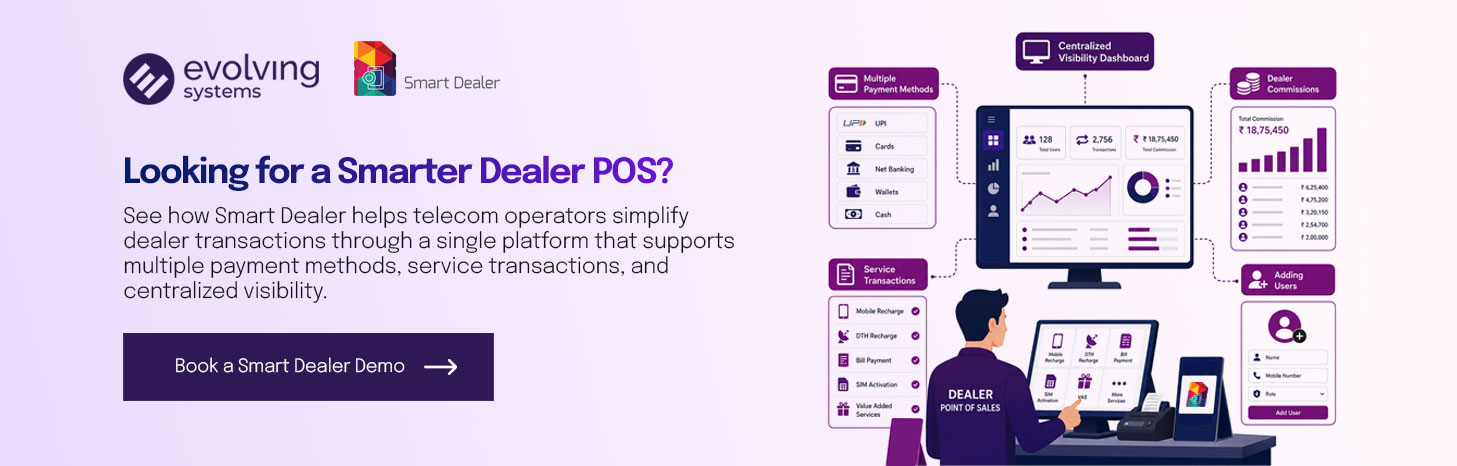
By bringing payments, service transactions, and dealer operations together through a single interface, Smart Dealer helps operators create a more efficient and connected retail experience.
What Modern POS Means for Telecom Dealers
The term “point of sale” often brings to mind a payment terminal or cash register. In telecom, however, the role of a POS extends much further.
A modern dealer POS acts as a transaction hub that supports the complete customer interaction. Rather than focusing solely on payment acceptance, it enables dealers to process a wide range of transactions through a unified workflow.
These interactions may include:
- Account top-ups and recharges
- Bill payments
- Subscription renewals
- Voucher and digital product sales
- Customer account transactions
- Multiple payment methods through a single interface
The goal is simple: reduce friction at the moment revenue is generated.
Customers increasingly expect flexibility in how they pay. Dealers expect systems that help them serve customers quickly. Operators need visibility and control across their retail channels. A modern POS helps bring these requirements together.
The Hidden Cost of Fragmented Dealer Transactions
Many telecom operators already recognize the challenges associated with fragmented systems. Yet these issues often persist because they emerge gradually as services, channels, and payment options expand.
Multiple Payment Systems
Customers want choice when making payments. They may prefer cash, cards, mobile wallets, QR-based payments, or other digital methods.
Without a unified transaction platform, dealers often find themselves switching between devices, applications, and payment interfaces. Every additional step increases transaction time and creates opportunities for error.
Separate Service Portals
Payment acceptance is only part of the transaction journey.
Dealers frequently need to access separate portals for top-ups, bill payments, voucher sales, or account-related services. This fragmentation slows service delivery and increases training requirements for frontline staff.
Every additional payment application, portal, or device introduces friction at the exact moment revenue is generated.
ERP Doesn’t Solve the Point-of-Sale Problem
Many operators are upgrading ERP environments to improve inventory management, financial control, and operational reporting.
These initiatives deliver significant value. However, they do not eliminate the need for a dedicated dealer transaction layer.
An ERP is designed to manage business processes and records. A POS is designed to facilitate customer transactions.
An ERP manages what happens after a transaction. A POS manages the transaction itself. Telecom operators need both.
As operators modernize their technology stacks, maintaining a strong point-of-sale experience becomes just as important as improving back-office operations.
Limited Visibility Across Dealer Channels
When transactions are spread across multiple systems, obtaining a consolidated view of dealer activity becomes difficult.
Operators may struggle to understand transaction volumes, payment trends, service adoption rates, or regional performance patterns in real time.
This limits their ability to respond quickly to changing customer demand.
How Smart Dealer Changes the Model
Smart Dealer addresses these challenges by creating a unified transaction environment for dealer networks.
Rather than forcing dealers to navigate multiple systems, the platform provides a single interface through which transactions can be initiated, processed, and tracked.
A Unified Transaction Layer
Smart Dealer acts as the operational layer between customers, dealers, and back-office systems.
Dealers can access the services they need from one location, helping reduce complexity and create a more consistent customer experience.
Support for Multiple Payment Methods
Smart Dealer enables multiple payment methods within a single environment, helping dealers process transactions efficiently without constantly switching between tools.
Service Transactions Beyond Payments
Telecom retail environments involve much more than payment collection.
The platform supports a range of dealer-driven transactions, helping operators deliver services through a consistent workflow while reducing operational friction.
Centralized Visibility and Control
While dealers benefit from a simplified user experience, operators gain greater oversight.
Transaction activity can be monitored centrally, providing better visibility into channel performance and helping support informed decision-making across the business.
Under the Hood: Built for Modern Telecom Operations
While the user experience is designed for simplicity, Smart Dealer is supported by capabilities that help operators scale and integrate efficiently.
Cloud-Ready Architecture
The platform is designed to support modern deployment models, helping operators scale transaction volumes while maintaining operational reliability.
API-First Integration
Smart Dealer can integrate with existing business systems through modern APIs, making it easier to connect with ERP, CRM, billing, and other operational platforms.
Role-Based Security
User permissions and access controls help ensure that dealers, supervisors, and administrators can operate within clearly defined responsibilities.
Centralized Management
Operators can manage users, transactions, and operational processes from a centralized environment, helping create consistency across dealer networks.
Real-Time Reporting
Transaction data becomes available as activity occurs, providing timely insights into channel performance and customer engagement.
Simplifying the Transaction Layer
As telecom operators modernize their technology environments, dealer channels cannot be left behind.
Back-office systems provide the foundation for operational efficiency, but customer interactions still happen at the point of sale. If those interactions remain fragmented, complexity simply shifts from one part of the business to another.
Smart Dealer helps bridge that gap.
By bringing payments, service transactions, dealer operations, and reporting together through a unified platform, operators can create a faster experience for customers, a simpler workflow for dealers, and better visibility across the entire retail channel.