Faster Campaign Execution: Turning Telecom Growth Plans into Action
AI-Powered Key Takeaways


Telecom operators are under constant pressure to drive growth. New offers, targeted promotions, loyalty initiatives, and customer engagement campaigns have become essential tools for increasing revenue and reducing churn.
The challenge is that identifying an opportunity is often the easy part. Turning that opportunity into a live customer campaign can take far longer than expected.
For MVNOs and Tier-2 operators, those delays can be costly. While teams coordinate approvals, configure systems, and prepare launch plans, market conditions continue to evolve and competitors continue to move.
In telecom, competitive advantage is no longer defined solely by who has the best offer. Increasingly, it belongs to the operator that can launch, test, and optimize that offer first.
Why Speed-to-Market Matters More Than Ever
Telecom markets have become increasingly competitive. New offers can be replicated quickly, customer expectations continue to rise, and digital-first competitors are accelerating the pace of change.
For smaller operators, speed often represents the most practical advantage available. They may not have the marketing budgets, subscriber scale, or network footprint of larger incumbents, but they can compete through agility.
The ability to launch a campaign quickly allows operators to respond to market trends, capitalize on seasonal opportunities, and engage customers while demand is highest.
Campaign delays, on the other hand, create a gap between identifying an opportunity and generating revenue from it.
What Slows Campaign Execution?
Most operators do not struggle because they lack campaign ideas. They struggle because executing customer lifecycle initiatives often involves multiple teams, systems, and approval processes.
Marketing teams define the offer. Operations teams prepare implementation plans. IT teams configure systems. Distribution teams require communication and enablement. Each handoff introduces additional complexity.
In many organizations, campaign management still relies heavily on manual processes, spreadsheets, and disconnected tools.
A simple promotion may require multiple rounds of configuration before it can reach customers. More complex initiatives involving loyalty rewards, targeted offers, or customer lifecycle journeys often take even longer.
The result is a process that becomes increasingly difficult to scale.
The Hidden Cost of the Blank Canvas Approach
One of the most overlooked barriers to faster customer lifecycle execution is the tendency to start from scratch.
Many operators approach every new campaign as a completely new project. Audiences need to be defined, triggers need to be created, customer journeys need to be mapped, and communications need to be planned.
While customization is important, rebuilding common campaign structures repeatedly creates unnecessary delays.
Consider some of the most common telecom customer engagement initiatives:
- Welcome journeys for new subscribers
- Recharge stimulation campaigns
- Usage growth initiatives
- Cross-sell and upsell programs
- Early retention campaigns
- Churn prevention efforts
These are not new concepts. They are proven customer lifecycle activities that operators execute repeatedly.
Yet many teams continue to invest significant time designing them from the ground up.
The challenge is not technology. The challenge is reinventing processes that already have established best practices.
The Business Impact of Slow Campaign Launches
When campaign execution slows down, the impact extends far beyond operations.
Revenue opportunities may be missed because offers reach customers after peak demand has passed. Competitors may launch similar promotions first and capture attention before others can respond.
Delayed execution also limits experimentation.
Operators that require weeks or months to launch a campaign naturally test fewer ideas. Fewer campaigns create fewer learning opportunities, making it harder to understand what drives customer engagement and revenue growth.
There is also an internal cost.
Teams spend valuable time coordinating activities, resolving dependencies, and managing approvals instead of focusing on optimization and innovation.
Over time, these inefficiencies can significantly reduce an operator’s ability to respond to market changes.
Faster Customer Lifecycle Execution Starts with Reusable Journeys
High-performing operators typically approach campaign execution differently.
Rather than treating every initiative as a unique project, they build repeatable frameworks that accelerate deployment.
Predefined customer journeys, reusable templates, automated triggers, and established segmentation models help eliminate unnecessary work.
This approach allows teams to focus on improving campaign performance rather than rebuilding campaign structures.
For example, a new customer onboarding campaign should not require extensive design work every time it is launched. The underlying journey remains largely consistent, while specific offers, communications, and targeting criteria can be adjusted as needed.
The same principle applies to retention campaigns, recharge stimulation programs, and cross-sell initiatives.
When operators have proven frameworks available, they can move from planning to execution significantly faster.
Building the Foundation for Faster Customer Lifecycle Execution
Improving campaign speed requires more than faster approvals. It requires an operational foundation designed for agility.
Several capabilities are particularly important.
Prebuilt customer lifecycle journeys help operators launch common campaigns without starting from a blank canvas.
Automated segmentation enables teams to target relevant audiences quickly and consistently.
Multi-channel engagement ensures customers receive communications through the channels they already use, whether through SMS, email, or app notifications.
Performance measurement provides visibility into campaign effectiveness, allowing teams to refine and optimize initiatives over time.
When these capabilities work together, operators can spend less time managing campaign logistics and more time driving measurable business outcomes.
Turning Speed into Sustainable Growth
Campaign execution speed should not be viewed solely as an operational metric.
Its real value lies in the business outcomes it enables.
Faster execution allows operators to engage customers earlier, test more ideas, optimize more frequently, and respond more effectively to changing market conditions.
It also helps reduce the gap between strategy and revenue generation.
For MVNOs and Tier-2 operators, this can be particularly valuable. Limited resources often mean every campaign must deliver maximum impact. The ability to deploy proven customer lifecycle initiatives quickly helps teams focus on results rather than implementation complexity.
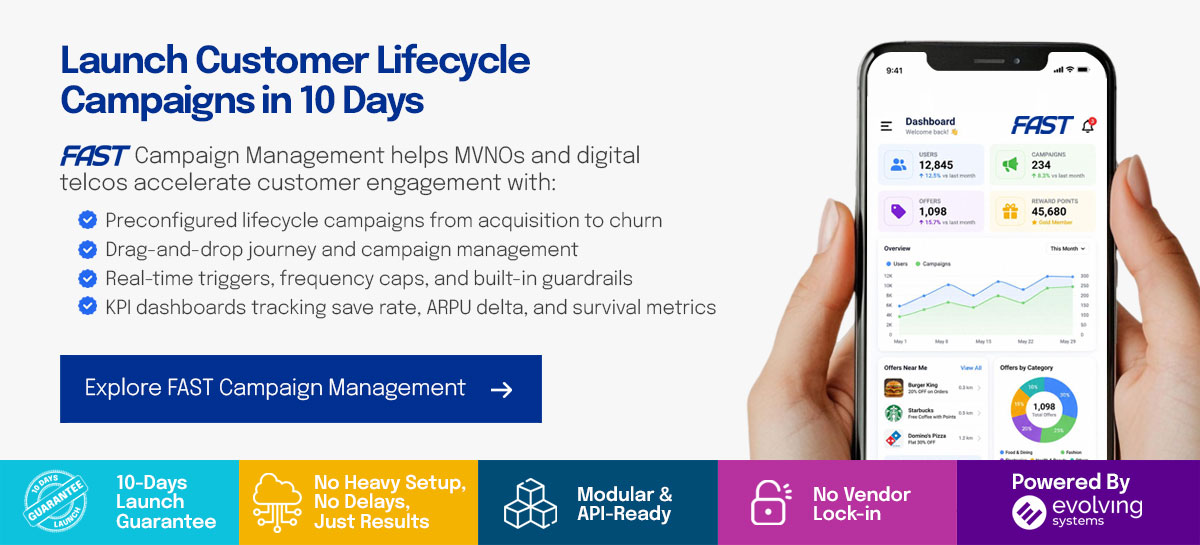
Solutions such as FAST Campaign Management support faster customer lifecycle execution through prebuilt journeys covering acquisition, onboarding, recharge stimulation, usage growth, retention, upsell, and churn management.
Rather than spending weeks building campaigns from scratch, operators can launch proven engagement programs quickly, optimize them continuously, and scale them as subscriber bases grow.
The challenge isn’t coming up with new campaign ideas. The challenge is turning those ideas into customer-facing experiences before the opportunity disappears.
The Bottom Line
The telecom industry has never lacked ideas for growth.
Operators launch new offers, promotions, loyalty initiatives, and customer engagement programs every day. The differentiator is no longer the ability to create those ideas; it is the ability to execute them efficiently.
As competition intensifies and customer expectations continue to evolve, customer lifecycle execution speed is becoming an increasingly important driver of growth.
Operators that reduce operational friction, leverage reusable customer journeys, and streamline campaign deployment can respond faster to opportunities and bring value to customers sooner.
Ultimately, growth does not happen when a campaign is approved. It happens when that campaign reaches customers. The faster operators can make that transition from idea to market, the better positioned they will be to compete and grow.