
Reduce Waste, Scale Faster: The ESG Value of Number Management
AI-Powered Key Takeaways


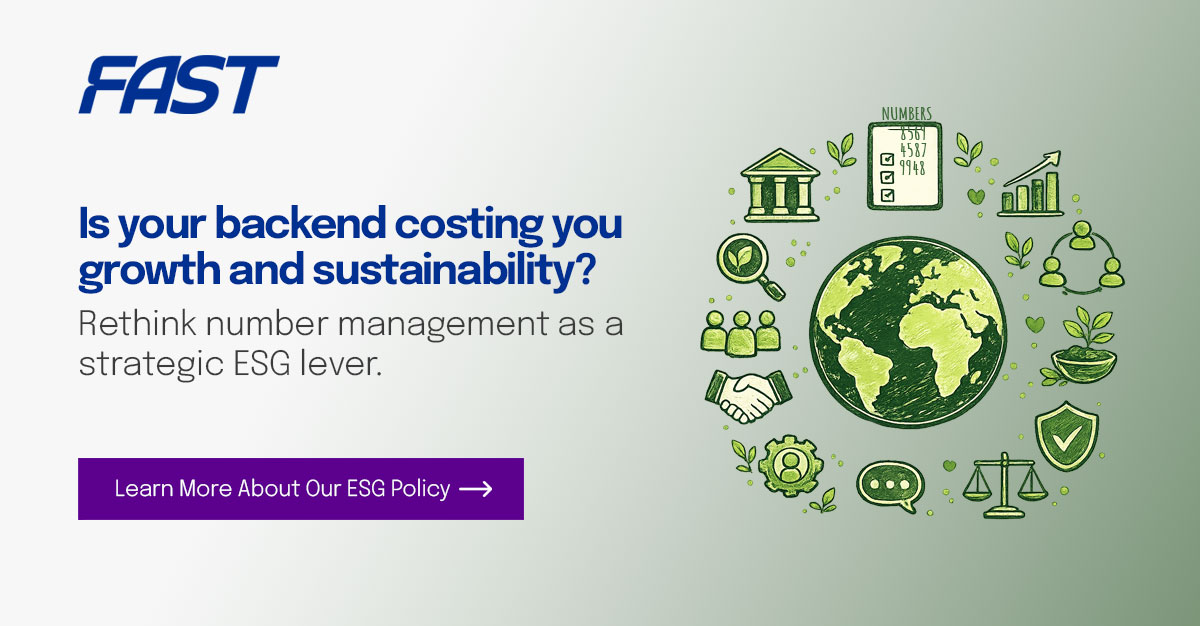
Sustainability in telecom is not only about towers or energy. For MVNOs and tier-2 operators, ESG progress often starts in the places customers never see, such as how efficiently scarce resources are managed. Numbering resources are finite. When inventory visibility is limited and lifecycle control is fragmented, waste increases, operations become heavier, and growth becomes less sustainable.
This article looks at why modern number management is becoming an ESG-aligned operational lever, and how FAST Number Management helps operators improve utilization, reduce operational overhead, and scale responsibly without adding complexity.
The Reality: Complexity Is Increasing, Margins Are Not
The telecom environment is becoming more complex, even for smaller operators.
- Subscriber expectations are rising
- Multi-service offerings are becoming standard
- Regulatory requirements continue to evolve
At the same time, MVNOs and tier-2 operators must operate within tighter cost structures.
This creates a unique challenge: doing more with less, while maintaining agility.
In such an environment, inefficiencies in core operations, especially those that scale with growth, can quickly erode margins.
Why Number Management Deserves More Attention
Numbering resources are foundational to telecom services. Every activation, every service request, every customer interaction depends on it.
Yet, many operators still rely on:
- Manual processes
- Fragmented systems
- Limited visibility into number usage
This leads to familiar issues:
- Underutilized number ranges
- Delays in provisioning
- Increased dependency on operational teams
- Difficulty in scaling efficiently
For MVNOs in particular, where speed and flexibility are key differentiators, these challenges can directly impact competitiveness.
The Cost of Inefficiency
Inefficient number management is not just a technical problem; it has clear business implications.
- Revenue leakage from unused or poorly allocated numbers
- Delayed service activation, impacting customer experience
- Higher operational costs due to manual intervention
- Compliance risks due to lack of centralized control
For tier-2 operators, these inefficiencies are amplified. Without the buffer of large-scale infrastructure or resources, even small operational gaps can have a disproportionate impact.
What Modern Number Management Should Look Like
To stay competitive, MVNOs and tier-2 operators need to rethink number management as a strategic capability.
A modern approach should include:
- Real-time visibility into number inventory and usage
- Lifecycle-based management to optimize allocation and recycling
- Automation to reduce manual dependency
- Scalability to support growth without operational strain
The goal is simple: ensure that numbering resources are always available, optimally utilized, and easy to manage; without adding complexity.
FAST Number Management: Built for Agility and Control
FAST Number Management is designed to address exactly these challenges.
Rather than adding layers of complexity, it simplifies and centralizes how numbering resources are managed, giving operators greater control with fewer resources.
Centralized Control
A unified view of all numbering resources allows operators to manage inventory more effectively. This reduces fragmentation and improves decision-making.
Lifecycle-Based Management
Numbers are managed across their full lifecycle – from allocation to activation, dormancy, and recycling. This ensures better utilization and reduces waste.
Automation and Accuracy
Manual processes are minimized, reducing the risk of errors and speeding up operations. Provisioning becomes faster and more reliable.
Scalability Without Overhead
As subscriber bases grow, the system scales seamlessly; without requiring proportional increases in operational effort.
For MVNOs and tier-2 operators, this translates into a more agile and efficient operational model.
Operational and Business Impact
Modernizing number management delivers immediate and measurable benefits:
- Improved utilization of numbering resources
- Faster service provisioning and activation
- Reduced operational costs
- Enhanced compliance and reporting
- Better customer experience
More importantly, it allows operators to focus on growth, without being constrained by backend inefficiencies.
Preparing for What’s Next
The demands on telecom operators will only continue to increase.
With the rise of IoT, multi-device connectivity, and evolving service models, the pressure on numbering resources will grow. Operators will need systems that can adapt quickly, without adding operational complexity.
For MVNOs and tier-2 players, this is not just about keeping up, it is about staying competitive in a fast-moving market.
Turning a Backend Function into a Strategic Asset
Earth Day serves as a reminder that sustainability is often driven by how efficiently resources are used, not just by large, visible initiatives.
For MVNOs and tier-2 operators, this principle is already part of everyday operations. Doing more with less is not optional, it is essential.
Number management sits at the heart of this equation.
By modernizing this layer, operators can improve utilization, reduce operational overhead, and scale more efficiently. These gains are not just good for business, they contribute to more responsible use of finite resources.
In a market where agility matters as much as scale, number management is no longer just an operational necessity. It is a sustainable competitive advantage.a
From Efficiency to ESG Impact
To understand how these operational efficiencies align with a broader sustainability vision, explore Evolving Systems’ ESG policy. It outlines how focused, practical interventions across platforms like FAST Number Management are helping operators reduce waste, improve accountability, and build more responsible, future-ready telecom ecosystems.