
Why Tier-2 Operators Need a Different Modernization Strategy Than Tier-1 Telcos
AI-Powered Key Takeaways


Telecom modernization has become one of the industry’s biggest priorities. Across the market, operators are investing in cloud-native platforms, AI-driven operations, digital customer experiences, and large-scale transformation initiatives designed to prepare their businesses for the next phase of growth.
But much of this conversation is still shaped by the realities of Tier-1 telecom operators.
Large operators have the budgets, scale, resources, and timelines to support multi-year transformation programs. Tier-2 operators, regional providers, and emerging telecom entrants operate in a very different environment. Yet many still approach modernization using frameworks designed for organizations far larger than themselves.
That disconnect often creates more operational pressure instead of reducing it.
Modernization Looks Very Different Outside Tier-1 Telecom
Tier-1 operators modernize at scale. Their transformation strategies are designed around massive subscriber bases, multi-market operations, large IT ecosystems, and long-term infrastructure evolution.
For smaller and regional operators, the priorities are often far more immediate:
- Faster go-to-market timelines
- Leaner operational models
- Faster ROI realization
- Lower transformation risk
- Greater operational visibility
- The ability to scale without significantly increasing overhead
The challenge is that many modernization programs still assume operators have the time, budgets, and internal resources to absorb lengthy transformation cycles.
For Tier-2 operators, that assumption rarely holds true.
A delayed rollout, operational disruption, or poorly aligned transformation initiative can directly affect revenue growth, customer experience, and market competitiveness.
The Real Pressure Point Is Operations
For many emerging operators, modernization challenges do not begin at the infrastructure layer. They begin inside day-to-day operations.
Subscriber onboarding delays, fragmented dealer ecosystems, disconnected workflows, manual provisioning, and poor operational visibility often create far bigger business bottlenecks than the network itself.
In many cases, operators are already working with a mix of legacy and newer systems that were added incrementally over time. While these systems may individually solve specific problems, they often create operational fragmentation across the business.
That fragmentation usually shows up in areas such as:
- Dealer and distributor management
- KYC and onboarding workflows
- SIM and number allocation
- Customer lifecycle management
- Product launch coordination
- Partner integrations
- Reporting and operational visibility
The result is an environment where scaling operations becomes increasingly difficult.
Teams spend more time managing workarounds, reconciling systems, and resolving operational inefficiencies instead of focusing on growth and customer experience.
Why Copying Tier-1 Transformation Models Often Backfires
Large-scale transformation programs can look attractive on paper. They promise long-term scalability, future-ready architecture, and complete operational reinvention.
But for Tier-2 operators, these initiatives often introduce challenges of their own.
Long implementation timelines can slow down responsiveness. Large platform overhauls can increase operational disruption. Monolithic modernization programs can delay value realization for months or even years.
Meanwhile, market conditions continue to evolve rapidly.
New telecom entrants are under pressure to launch faster. Regional operators need to respond quickly to local market shifts. MVNOs increasingly compete through differentiated customer experiences and service agility rather than infrastructure scale alone.
That creates a very different modernization requirement.
Instead of asking, “How do we completely transform the business over five years?” many operators are now asking:
- How do we reduce operational friction quickly?
- How do we scale without increasing complexity?
- How do we improve agility without disrupting ongoing operations?
- How do we modernize incrementally while continuing to grow?
Those questions require a different strategy altogether.
The Rise of Modular Modernization
This is one reason modular modernization is gaining traction among Tier-2 operators and MVNOs.
Rather than committing to large monolithic transformation programs, operators are increasingly adopting more flexible modernization approaches that allow them to improve specific operational areas without disrupting the broader business.
Modular platforms make it easier to modernize incrementally, prioritize immediate business needs, and scale capabilities as operational complexity grows.
For operators managing leaner teams and tighter timelines, that flexibility becomes critical.
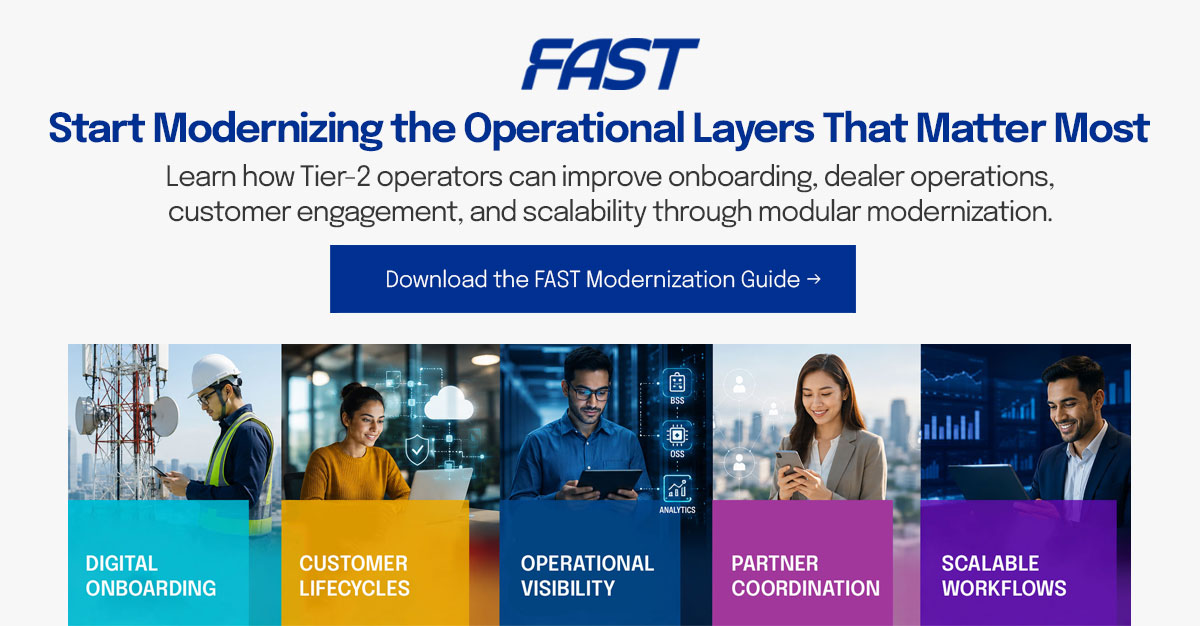
FAST is designed around this modular modernization approach. Instead of forcing operators into large-scale transformation cycles, it allows telecom providers to modernize specific operational areas based on immediate business priorities while retaining the flexibility to scale over time.
That becomes particularly valuable in areas where operational efficiency directly impacts customer experience and speed-to-market.
For many emerging operators, modernization success is no longer defined by how much technology they replace.
It is defined by how effectively they reduce operational friction.
A Smarter Modernization Mindset for Emerging Operators
The telecom industry is entering a phase where agility, operational efficiency, and scalability are becoming more important than transformation size alone.
Tier-2 operators do not necessarily need smaller versions of Tier-1 transformation programs. They need modernization strategies aligned with their own business realities.
That often means prioritizing:
- Faster time-to-value
- Operational simplicity
- Scalable modular systems
- Automation-driven workflows
- Better cross-functional visibility
- Lower transformation risk
- Flexibility to evolve incrementally
The operators that succeed in the coming years will likely not be the ones pursuing the largest transformation programs.
They will be the ones modernizing the operational layers that directly influence responsiveness, customer experience, and sustainable growth.
And for emerging telecom players, that distinction matters more than ever.