
The Lean Telco Playbook: Why MVNOs Must Decouple from Legacy IT to Survive Macro Pressures
AI-Powered Key Takeaways


The global telecom landscape has arrived at a critical turning point. Modern agile operators face a multi-directional margin squeeze: hyper-price-sensitive consumers fighting inflation on one side, and sticky, non-negotiable wholesale network costs on the other.
For Mobile Virtual Network Operators (MVNOs), tier-2 national brands, and new market entrants, traditional commercial growth tactics are officially broken. Data commoditization has turned standard connectivity into a pure utility, meaning that expanding your subscriber base no longer guarantees a healthy bottom line. To survive in this climate, sustainable profitability must be won through two highly specific operational metrics:
- Margin Efficiency: Systematically stripping out hidden transactional, IT, and operational waste.
- Velocity of Time-to-Market: Launching tailored commercial offers and reactive promotions before the competition can even schedule a scoping meeting.
Yet, as lean teams try to execute at pace, they continuously slam into an invisible brick wall: legacy Business Support Systems (BSS). These rigid architectures have transformed from historical foundations into proactive margin killers. To remain viable, operators must urgently pivot toward a “Lean Telco” model: decoupling their customer-facing business engines from massive, monolithic codebases.
The Anchor Weight: Why Legacy Systems Crush Lean Teams
For decades, the standard telecom playbook dictated deploying massive, all-in-one software suites. While this comprehensive setup theoretically minimized vendor fragmentation, it introduced an architectural weight that a modern lean telco simply cannot support. For mid-market and greenfield operators, this approach doesn’t mitigate risk; it guarantees operational paralysis.
This rigid setup imposes an expensive, ongoing “bloat tax” on daily execution:
- The Change Bottleneck: Simple logic updates – like tweaking an automated campaign segment, modifying a regional dealer’s commission, or updating a loyalty tier – require custom engineering work, database updates, and regression testing.
- The Waiting Game: Lean operators spend months waiting for legacy vendors to deliver minor system updates, stuck in long queues behind tier-1 telcos with greater financial leverage and larger service-level agreements (SLAs).
- The Core Rigidity Trap: Because the commercial layer is deeply intertwined with core billing and network provisioning engines, any attempt to change a front-end promotion introduces a small but terrifying risk of knocking out active subscriber services.
- The Opportunity Cost: If a market competitor launches a sudden eSIM promotion, an operator anchored by legacy code will spend weeks just scope-testing the implementation. By the time it goes live, the customer acquisition window has slammed shut, and market share is lost.
Pillar 1: Agility Over Infrastructure (Launch in Weeks, Not Months)
True competitiveness is no longer defined by how many features your IT platform possesses on paper or how massive your server architecture is. Instead, it is measured by execution velocity, how quickly your business team can turn a strategic idea into a live, revenue-generating customer touchpoint.
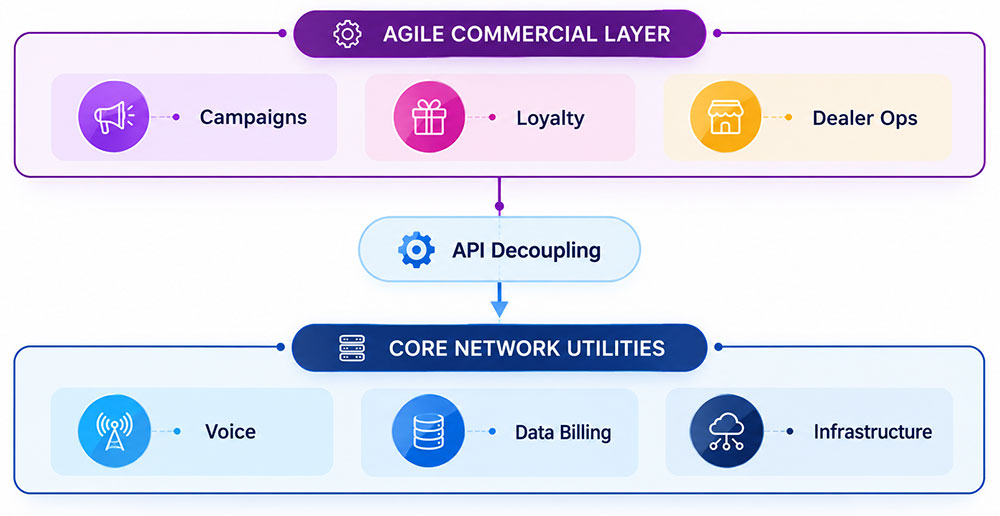
By separating core network utilities from commercial engagement systems via lightweight APIs, teams can deploy plug-and-play modules without risking network stability:
- Fintech-Like Speed: Small telecom teams can operate like agile fintech apps rather than slow, traditional utility companies, running circles around slow-moving competitors.
- Real-Time Execution: Instead of broad, wasteful, and expensive broadcast SMS campaigns, teams can deploy micro-targeted triggers based on live consumer behavior (e.g., location-based data bumps or instant top-up rewards).
- Dynamic Adjustments: Field agents and regional distributors are empowered with mobile tools to adjust distribution strategies, track stock lines, and pivot sales focus based on immediate, hyper-local demand.
- Independent Iteration: Product managers can continuously A/B test marketing offers, loyalty rewards, and dealer incentives in isolation, without submitting an IT ticket to core engineering.
Pillar 2: Capital Efficiency (Paying Only for What You Grow)
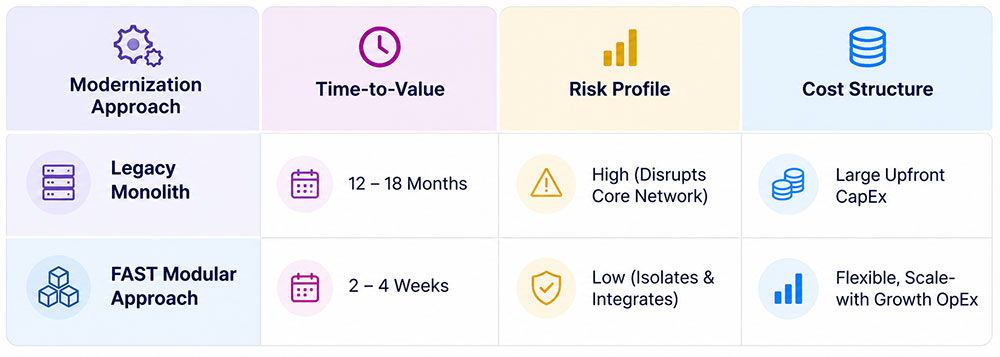
Legacy IT systems demand heavy upfront capital expenditure (CapEx) for hardware procurement, lengthy systems integration, and upfront software licensing agreements. For budget-conscious operators and greenfield MVNOs, locking up millions in tech infrastructure before onboarding a single subscriber is highly dangerous.
The lean model replaces this outdated dynamic with a “Start Small, Scale Smart” mentality:
- OpEx Predominance: Shifting commercial expenses to predictable, consumption-based cloud pricing directly improves unit economics and customer acquisition cost (CAC) ratios from day one.
- Prioritized Levers: A brand-new greenfield MVNO doesn’t need a complex enterprise loyalty engine in week one. They need flawless automated dealer onboarding and streamlined number allocation to capture initial market share.
- Self-Funding Growth: As the business expands and subscriber volumes grow, the operator can activate additional retention modules – funding tech expansion directly from active, verified cash flow rather than burning venture capital.
- Eliminating Zero-Value Waste: Operators stop paying for dormant features, unused user seats, and bloated server space that they hope to grow into five years down the line. Instead, tech spend scales seamlessly alongside real subscriber demand.
The FAST Path: Transitioning to Modular Modernization
This philosophy drove the development of the FAST – Modular Telecom Platform by Evolving Systems. Purpose-built for agile operators who need immediate market impact without infrastructure complexity, FAST serves as the definitive bridge away from legacy constraints.
Rather than forcing a risky, all-at-once “rip and replace” migration of your entire BSS stack, the FAST framework allows operators to modernize progressively via five tailored, API-ready modules:
- Campaign Management: Automates hyper-personalized user engagement using real-time behavioral triggers and smart audience segments, all via an intuitive, unified central dashboard with available templates.
- Loyalty Management: Launches experiential digital wallets, retention-boosting rewards, and gamified tiers to boost ARPU without heavy development or infrastructure overhead.
- Number Management: Streamlines full physical SIM/eSIM lifecycles, automated resource inventory tracking, recycling loops, and direct monetization of high-value golden numbers via a centralized cloud platform.
- Dealer Management: Digitizes the physical distribution network completely, managing field agent onboarding, stock allocation, and SIM activation via a mobile-first app designed specifically for the field.
- Dealer & Commission Management: Motivates sales partners and protects operating margins by automating complex payout structures, eliminating manual validation errors, and ditching spreadsheets.
Conclusion & Strategic Next Steps
In today’s highly competitive, cost-conscious telecom market, being a Lean Telco isn’t about how many subscribers you serve, but how quickly and efficiently your business can respond to change. The real advantage comes from having operations that let marketing, sales, and distribution teams launch new initiatives, adapt to market demands, and capture growth opportunities without adding unnecessary cost or complexity.
By adopting modular capabilities where they are needed most, operators can address operational bottlenecks, protect margins, and improve efficiency without overhauling their entire technology environment. This approach not only delivers results today but also builds a stronger foundation for future growth.
The goal is simple: grow your business without growing operational complexity. With the right capabilities in place, operators can move faster, operate leaner, and scale with confidence.