
The Build vs. Buy Trap in MVNO Technology Decisions
AI-Powered Key Takeaways


Every MVNO reaches the same crossroads.
Should you build your own technology stack or purchase proven solutions from specialist vendors?
At first glance, the decision appears straightforward. Building offers complete control and flexibility, while buying promises faster deployment and lower upfront effort.
But that comparison misses a far more important question.
The real challenge isn’t deciding whether to build or buy.
It’s deciding what deserves to be built in the first place.
Many operators spend months developing operational capabilities that customers never notice. By the time those systems are ready, competitors have already launched new services, entered new markets, and acquired subscribers.
Technology should accelerate business growth.
Too often, it delays it.
“The smartest MVNOs don’t ask, ‘Should we build or buy?’ They ask, ‘What capabilities will actually differentiate our business?'”
Why Building Is So Appealing
It’s easy to understand why many operators lean toward building.
Owning the codebase provides complete control over the product roadmap. Features can be tailored to specific business processes, integrations can be designed around existing systems, and engineering teams aren’t constrained by a vendor’s release schedule.
For technology-led organizations, building can also feel like a strategic investment.
The logic is compelling:
- Create a platform that fits the business instead of adapting the business to software.
- Avoid vendor lock-in and retain ownership of intellectual property.
- Develop capabilities that competitors cannot easily replicate.
In the right circumstances, those are valid reasons.
The problem is that many MVNOs extend this thinking to every operational capability, even those that offer little competitive advantage.
The Cost of Building Doesn’t End at Launch
One of the biggest misconceptions in technology planning is treating software development as a one-time project.
In reality, launching a solution is only the beginning.
Every custom-built capability requires continuous investment in maintenance, testing, security updates, infrastructure, documentation, monitoring, integrations, and regulatory compliance. New business requirements create new development cycles. Platform upgrades trigger additional testing. Third-party APIs evolve. Customer expectations change.
What looked like a six-month project gradually becomes a permanent engineering responsibility.
These ongoing commitments rarely appear in the original business case.
Yet they often represent the largest share of long-term ownership costs.
Every Month Spent Building Is Also a Business Decision
Technology roadmaps don’t exist in isolation.
While engineering teams are building internal systems, the market continues moving.
Competitors launch new offers. Distribution partnerships are signed. Customer expectations evolve. Revenue opportunities don’t pause simply because a platform is still under development.
A delayed launch doesn’t only affect the IT roadmap.
It affects the business roadmap.
Waiting six months to launch a campaign engine or dealer management platform may also mean six months of delayed subscriber acquisition, slower market expansion, and postponed revenue generation.
Time-to-market should never be viewed solely as a project milestone.
It’s a competitive advantage.
“The biggest cost of building isn’t development effort. It’s everything the business couldn’t achieve while the platform was still being built.”
Build What Makes You Different
Not every capability deserves custom development.
Some create genuine competitive advantage.
Others simply help the business operate efficiently.
Confusing the two is where many technology strategies go wrong.
Before committing engineering resources, operators should ask four simple questions:
Q1: Will customers actively choose our service because of this capability?
Q2: Does it create a competitive advantage that competitors will struggle to replicate?
Q3: Is this central to our long-term business strategy?
Q4: Will it evolve faster than commercial software can realistically support?
If the answer to most of these questions is yes, building may be the right decision.
If not, buying or adopting an existing solution often delivers greater business value.
Customer-facing innovation, AI-driven personalization, unique pricing models, and proprietary analytics frequently justify internal investment because they shape how customers experience the brand.
Operational capabilities such as dealer management, campaign execution, commission processing, loyalty administration, and numbering management rarely influence purchasing decisions directly.
Customers expect these capabilities to work.
They don’t choose an operator because they were custom built.
Modern MVNOs Win with Composable Technology
The most successful MVNOs are no longer trying to build a single platform that does everything.
Instead, they’re assembling technology ecosystems that combine specialist solutions through modern APIs.
This composable approach allows operators to innovate where it matters while relying on proven platforms for operational excellence.
Rather than stretching engineering teams across every business function, operators can focus their efforts on initiatives that directly improve customer acquisition, engagement, and retention.
The result is greater agility.
New capabilities can be introduced faster. Existing systems can evolve independently. Technology decisions become driven by business priorities instead of development capacity.
Perhaps most importantly, engineering talent remains focused on creating competitive differentiation rather than rebuilding standard operational processes.
Where Should MVNOs Invest Their Engineering Talent?

The smartest MVNOs don’t build everything. They build what makes them different.
Where FAST Fits
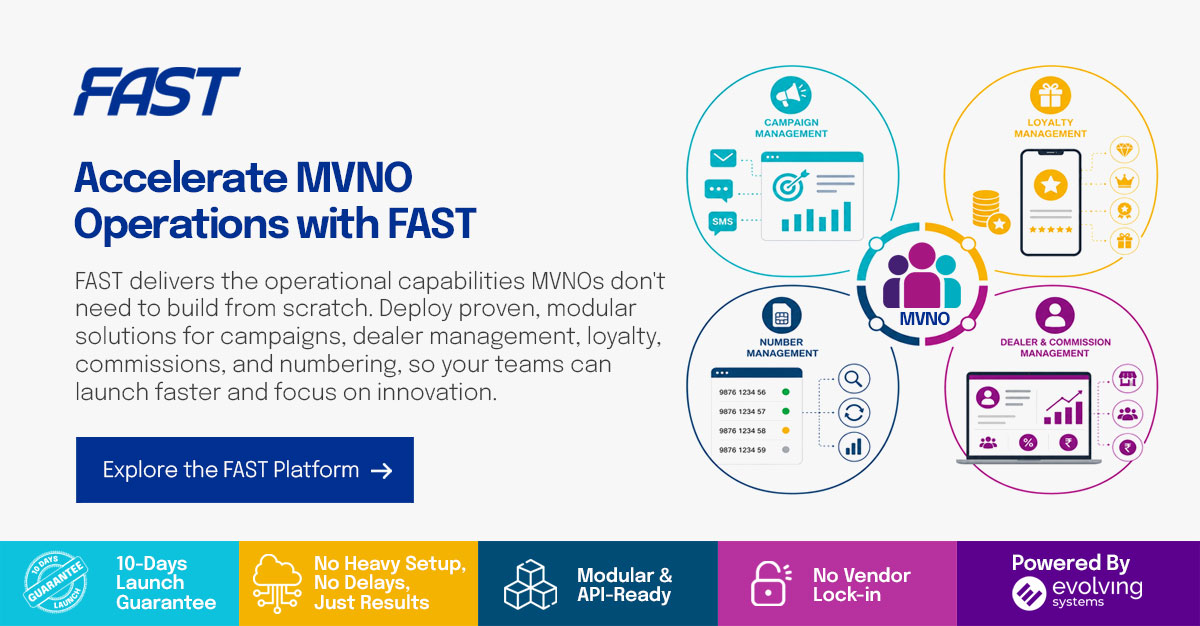
Dealer management, campaign management, loyalty programs, commission processing, and numbering operations are essential to running a modern telecom business.
They are also capabilities that have already matured across the industry.
Rebuilding them from scratch rarely creates additional market value.
FAST provides these operational capabilities as modular, configurable solutions that integrate seamlessly into existing MVNO ecosystems.
Rather than replacing internal innovation, FAST enables it.
Operators can accelerate deployment of critical business functions while allowing internal teams to concentrate on customer experience, digital innovation, pricing strategy, and other initiatives that genuinely differentiate the business.
This approach reduces implementation risk, shortens time-to-market, and frees engineering resources to focus where they deliver the greatest return.
Technology Should Enable Innovation, Not Consume It
Every technology investment represents a choice.
Choosing to build one capability often means postponing another.
Engineering capacity is finite.
Time-to-market is finite.
Budgets are finite.
The question therefore isn’t whether building software is good or bad.
The question is whether every capability deserves the same level of investment.
The operators that outperform their competitors won’t necessarily be those that build the most software.
They’ll be the ones that invest their engineering talent where it creates the greatest strategic impact while adopting proven platforms for everything else.
Because in today’s MVNO landscape, competitive advantage doesn’t come from building more technology.
It comes from building the right technology.