
PART 1: Why Modular Modernization Is the New Path for MVNOs and Tier-2 Operators
In an industry where agility is the new currency, mobile virtual network operators (MVNOs) and tier-2 carriers find themselves at a crossroads. The pressure to innovate is relentless, yet traditional transformation approaches often leave these operators trapped between mounting customer demands and limited resources.
The pain is real: slow launches, fragmented customer experiences, and operational overhead that outpaces growth. How do you compete—and win—when every month brings new challenges, and every delay comes at a cost? For many, the answer lies not in a full-stack overhaul, but in a smarter, more flexible approach that addresses bottlenecks where they hurt most and delivers results faster.
MVNOs and tier-2 operators don’t have the luxury of long, risky transformation programs. Growth targets outpace internal capacity. Customer expectations change faster than legacy processes, and distribution expands faster than most back offices can keep up.
That reality is why modular modernization has become the preferred path forward.
Traditional “big-bang” transformation approaches often assume you have the time, budget, and internal runway to rebuild multiple systems at once. For many operators, that is simply not true. What is true is the need to remove bottlenecks quickly, prove value early, and scale in manageable stages.
Modular modernization focuses on outcomes first. It gives operators a way to introduce digital capabilities where they will have the greatest impact, while continuing to use existing systems and processes that still work.
The Hidden Cost of Waiting
In fast-moving markets, the cost of delay is often higher than the cost of technology. When onboarding is inconsistent, activations slow down. When dealer operations depend on spreadsheets, errors and delays multiply. When number resources are fragmented, inventory waste increases. Over time, these “small” issues become structural constraints.
For operators scaling subscriber volumes, the impact tends to show up in three places:
- Time-to-launch increases just as the market demands faster offer cycles.
- Operational overhead grows faster than revenue.
- Customer experience fragments across channels, leading to early churn and increased support load.
Why Modular Beats Monolithic
Modern operators don’t just need a new stack. They need control, speed, and flexibility.
A modular approach supports this by allowing critical capabilities to be launched without waiting for an entire infrastructure overhaul. It enables operators to:
- Start with one high-priority capability, then expand over time.
- Integrate via APIs, instead of restructuring the entire environment.
- Operate lean, without creating a massive IT lift.
- Scale based on real demand, not projections.
This approach is especially practical for MVNOs and tier-2 operators seeking enterprise-grade results without the complexity.
What “Modernization” Really Means in Practice
For many operators, modernization is not about replacing everything. It is about removing friction from the workflows that directly affect growth:
- Faster onboarding and activation journeys
- Real-time campaign and loyalty execution
- Better control over number and SIM resources
- Digitized dealer operations and transparent commissions
These are the levers that help operators move from growth ambition to repeatable execution.
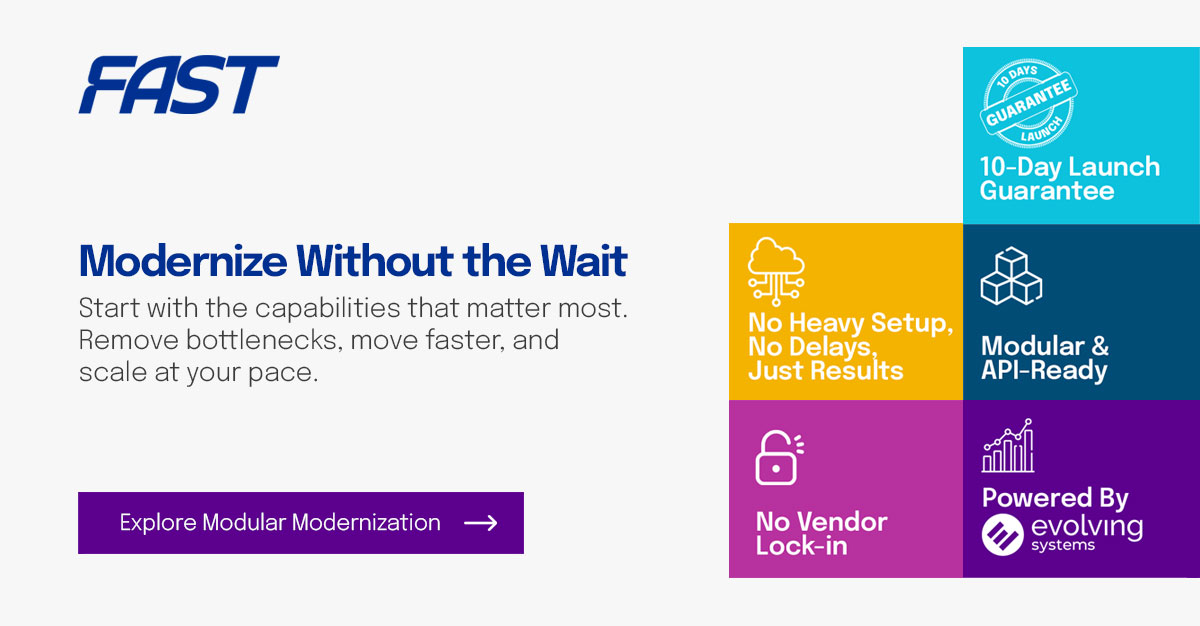
The FAST Approach: Launch Fast, Operate Lean, Scale on Your Terms
FAST was built for this reality. It is not positioned as a one-time transformation event. It is designed to help operators modernize in stages through modular adoption.
FAST enables operators to:
- Deploy the modules they need now.
- Add more capabilities later without replacing core systems.
- Improve operations without heavy setup.
- Move faster with lean teams.
In Part 2 of this article, we will break down how FAST modules map to operator types and common growth scenarios.